What to Do When Your Breakup Broke Your Health
So, I’m going through a breakup right now, and I cannot believe how easy it is to turn to comfort food.
I can, and I can’t.
After all, if science is correct, we are going through withdrawal in these moments.
And I’m sure our brains are looking for cheap dopamine to fill the void.
So how do you ensure that your breakup does not actually break your diet and your body?
And how do you make sure you eat well and exercise regularly through the grief?
The Quick Answer
The quick answer I have while going through this is: don’t worry about it.
Do what you need to do to process.
That common advice about what you do in a day, or a week, or a month, won’t affect you long term, and that’s true.
With that said, if you are on medications for chronic conditions such as diabetes, then you need to follow your doctor closely.
Why I Thought My Health Motivation Was Internal
Here’s what I’m realizing at this moment.
I thought my motivation for health was internal.
I thought I wanted to be healthy for me.
And the reason I thought that was because it felt good.
I wanted to be present in the world no matter what happens.
It turns out I had so much hope to make things work with that person that a lot of that motivation came from this hope.
So it seemed wholesome, and yet the motivation simply collapsed.
How Health Gets Tied to Your Future With Someone
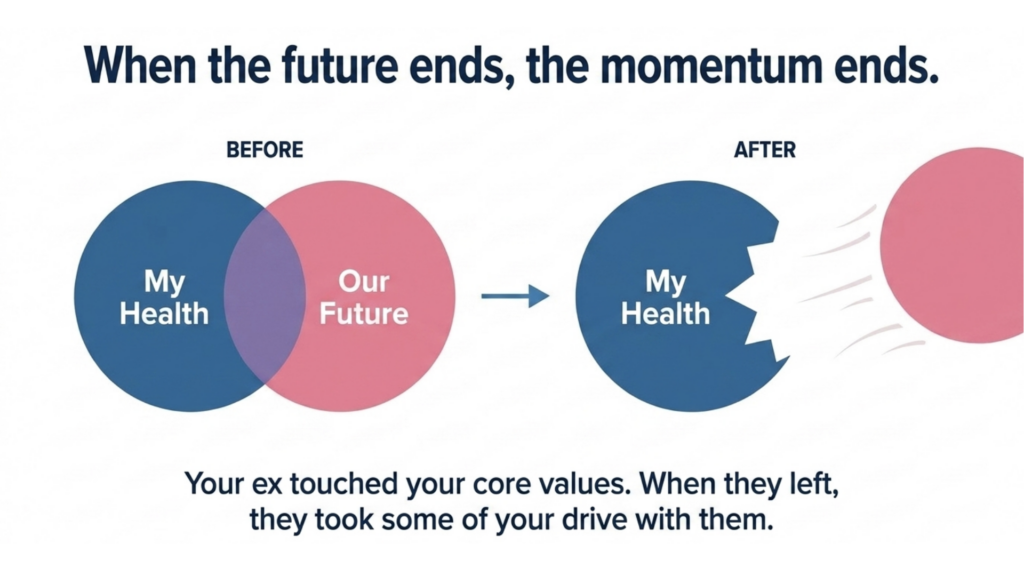
You get healthy and you don’t realize how your health is tied to the prospects of your future.
You are trying to be healthy with the idea that you’ll be sharing your life with someone.
So when that ends, naturally you lose momentum.
Because you had this grand vision you expected to create with your loved one, and now it’s just utterly… gone.
That person was in your innermost circle.
Which means they touched every single core value you have, including your health.
Even if the relationship ended badly, that motivation was deeply ingrained, to the point where it was affecting your values around your health and well-being on a fundamental level.
Why a “Revenge Body” Doesn’t Work
So how do we move on?
Like everyone else, I turned to the internet.
I turned to social media.
And I’ve been reading about this idea about a revenge body.
It’s a very tempting concept.
Although coming from a health and wellness coach perspective, it seems to me that’s definitely an external motivation.
Because in a sense you develop your body to make your ex jealous, or to try to get them back, or whatever.
And perhaps you succeed.
Maybe you do, maybe you don’t.
But what happens when you’re tired of that?
You stop working on your body.
You stop all the healthy habits, or at least the supposedly healthy habits.
You’re Still Building Your Body for Them
I really don’t think that’s for me, because you’re essentially trying to do things for that person.
You’re still building your body in the hopes of making the other person jealous, or you’re still building your body in the hopes of being in a better position to get them back, or in the hopes of being in a better position to maintain a better relationship with that person.
You don’t have the prospect of that life anymore.
The only prospect that you might have is that you have this hope of getting back together.
But then if you get back together, it’s still going to end up in the same way.
And so a revenge body essentially does the same thing in a negative way.
Because you’re still expecting to show up in their future as your best self just to make them jealous.
Like, “Oh, you’re still having difficulty losing weight? Look at me, I’m lean and I’m dating a supermodel.”
Or, “Oh, you’re still struggling with your finances? Look at me, I’m stacking cash and having a successful business.”
So you’re still doing things in a way to include that person in your life so that they can see you, so that they can see what they’re missing out on.
And that’s not going to end well either, because you’re still holding on to a relationship that you know will not work in the long term.
The Medical Yo-Yo Effect
So while I appreciate the idea of building a revenge body to get you through to the next level, or to get you through a valley of hardship.
It’s not something I think is sustainable for the long term.
And even on a medical level, it’s also difficult to sustain.
Because if you’re suddenly eating clean, let’s say you decide to go on a keto diet, but you’re on insulin, your blood sugars might crash, and that will cause all kinds of medical issues.
You’re going to have to go to your doctor more consistently to make sure that:
- your blood sugar levels are okay,
- that the medications you’re currently taking are still in balance with your body,
- that there’s nothing going on crazy with your blood work.
And then when you suddenly stop all of your efforts again, you’re going to have to go back to the doctor and make sure that everything is still in balance.
So it creates this unnecessary yo-yo effect, and it’s certainly keeping your body off balance, just not in a good way.
So your vision needs to change on a fundamental level.
Who are you regarding your health? And regarding your personal growth?
Filling the Void: Mindfully vs. Accidentally
It’s only natural to want to fill the void.
When you’re going through a breakup, you have the need to fill this void that has just been created.
And we can choose to fill that void mindfully, or we can choose to fill that void accidentally.
If by accident, that void can be filled with either good or bad habits.
How many people fill that void with:
- rebound relationships,
- or they try to fill it with junk food,
- or they try to fill it with alcohol or drugs.
There’s all kinds of ways to get that cheap dopamine hit in order to feel good again.
But it’s not going to work, not for the long term.
It might get you through a moment, but it’s not going to help you feel well and heal.
The Hoover Dam Metaphor
I think the Hoover Dam is kind of a great example.
Obviously, they’re generating power by channeling water in such a way as to produce the power through the generators.
And if the water becomes too much, there are overspill pathways.
That water is not necessarily being used to produce power, it’s just being lost, but it still needs to be channeled in the right direction.
Otherwise, it’ll flood everything down the line and all around it.
So you don’t want to be a flood of emotions necessarily.
You don’t want to be a flood of stress hormones.
You want to harness that raw energy that that river of stress created, and you want to channel it.
Exercise and Blood Sugar Control
And exercise certainly helps, and it’s probably one of the better things that you can do, especially for someone who has an A1C that they need to make sure stays under control.
And even in a body that has insulin resistance, or is prone to insulin resistance, now you have increased cortisol levels because of the stress and the grief.
You also have, as a result, a higher blood sugar level.
Exercise can help keep blood sugars in check.
Exercise as My New Comfort Food
And in a sense, I found exercise to be a comfort food.
It’s familiar.
It makes me feel good.
It helps me release disappointment.
And eating right doesn’t give me the same satisfaction as physical movement.
Food will fuel the movement, but even suboptimal fuel works in a pinch.
So, for example, if I feel bad or low, I’ll go outside, I’ll take a walk, give it an hour or two, and I may feel fine.
I may still feel terrible.
And you’ll feel bad in the first place for a reason, or several reasons.
And those reasons didn’t magically go away while you’re on a walk.
But at least with a walk, you go outside, get some fresh air, feel the sun or the rain on your body, and that sort of habit compounds over time.
It builds so you gradually and sustainably feel better.
We’re not chasing a high.
We’re chasing consistency.
Building a System You Can Trust
And if we’ve established a system with our diet, and with our exercise, and our sleep hygiene, no matter what happens on a day-to-day basis, you know that your system is optimal for your body’s health.
If you have medications, you take the medications every single day at the same time.
If you exercise, you exercise every day or every other day at the same time.
If you go to sleep, you go to bed every day at the same time, and you wake up every day at the same time.
You might feel more sleepy or groggy on some days than others, but you stick to that consistent schedule, because you know that sometimes there are going to be down swings and sometimes there are going to be upswings, but the trend gradually rises over time.
You gradually feel better and better, so that your worst days are better than your best days a year ago.
What Your A1C Trend Actually Tells You
Same thing with your A1C.
Your daily blood sugars can be up or down or sideways, but the A1C helps you understand what has been the trend over the last three months.
So if you’re above 7%, obviously you want it to trend downwards.
If you’re below 5.7%, you probably want it to trend sideways.
A Patient’s Story: When Hope Runs Out
And I want to take a minute to kind of stop here and talk about a patient who was very overwhelmed.
There was a moment where he quietly stopped taking medication, with the idea that he’s just going to let nature run its course.
And of course he knew that meant that he would pass away.
That’s a very dangerous place to be in when your life depends on that system.
Basically, he lost hope for a moment in time.
And ironically, there is a good way to lose hope, in the sense that it can help you move forward in life rather than take your life.
Talk to Yourself Like a Good Friend
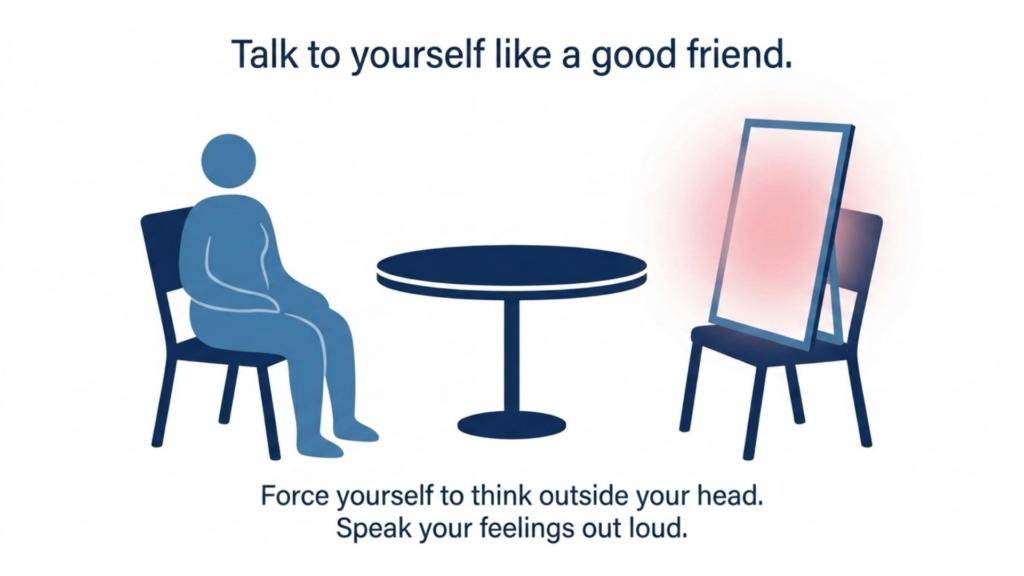
So, take the time to talk to yourself like you would talk with a good friend.
You would ask your friend, “How are you doing today? How are you feeling? Are you feeling okay?”
Basically, ask yourself these questions.
Pretend you’re sitting across the table from yourself. What would you say?
- How are you?
- What’s going on?
- How’s your day been?
- How are your blood sugars today?
- Did your doctor tell you anything interesting?
- What do you want to do today?
- Let’s go out for a walk and just chat.
- My ears are open, I’m listening.
- Tell me what you need.
And if you find that weird, it’s not really that weird, because we do this all the time.
We just don’t externalize it.
Or frankly, it’s not that weird, because if you have kids, you’re basically talking to yourself.
They are their own independent person, but at the same time they are an extension of you, and they reflect who you are.
They reflect your values.
So kids are a great mirror to look inside yourself and see who you really are, and how that’s being brought out into the world, and how that’s being reflected in the world.
The point is to force yourself to think outside of the box that you put yourself in.
Check in with yourself.
And by checking in with yourself, you can reconnect with your vision.
Reconnecting With Your Vision: Questions to Ask Yourself
So you can ask yourself these questions:
- Before this relationship, what did healthy mean to me, and just to me?
- When you strip away every reason tied to a shared future, who are you? What is left?
- What did you do for your health that had nothing to do with that other person, or for anyone else to notice?
- What value or values has your health always served, even before this relationship existed?
- Were you able to serve your community better? Did you value your sharp mind and intellect at your work or your business? Are you more creative? Do you find inspiration in the things that you do?
Ideally, that person would support you, but this is an opportunity to refine yourself, to refine who you are and how you walk in this earth.
Turning Vision Into Action
How do you reconnect to your vision? What is your vision? And now that you’ve reconnected:
- What’s the smallest version of your system that you can do today to serve that vision, to serve those values?
- What’s one familiar, comforting habit you can lean on instead of willpower? For me, I exercise. I go for walks.
- What would you tell a close friend sitting across the table from you right now, if they’re feeling what you’re feeling and they’re experiencing what you’re going through right now? How would you talk to them? How would you listen? What do you need to hear, and what do you need to vent?
- What’s one part of your old routine that you can pick back up this week? Even if it’s not perfect, but it realigns you with your core values, who you really are.
Questions to Bring to Your Doctor
And when we go through this, we need to bring questions forward to our doctors.
We need to tell them, “Hey, I’m going through a major stressor right now.”
It doesn’t necessarily have to be a breakup.
Maybe you lost a loved one, they genuinely passed away unexpectedly or expectedly.
Loss is always hard.
Grief is always difficult, but we have to go through it, and we have to do it in a responsible way.
So in the case of diabetes, you can ask the doctor:
- Given my current A1C and my current medical history, does this call for closer monitoring? Or is my baseline stable enough to ride it out?
- If my numbers run high for the next few weeks because of the stress, at what point does that become something we need to act on, versus something expected to just settle back down?
- Is there anything that we need to do with my current medication regimen? Do we need to change the dose? Do we need to add a different medication? Do we need to take away a medication?
This all really depends on how you change your diet, how you change your exercise levels, while you’re trying to cope through this situation.
Final Thoughts
So if you’re also going through a breakup, just remember that everything will be okay.
Your dreams, your vision will be better served through this process, with someone who can better support you.
So you’ll be better than okay. You’re going to be wonderful, and you will be well.
You’ll be okay.
Health and Wellness coaching
Would it be a bad idea to work together now?
If You’re Not Ready Yet, That’s OK.