
1 Piece of Toast Spikes My Blood Sugar (But Not Yours): Understanding Insulin Resistance
Okay, so how is it that somebody can eat a piece of toast and their blood sugars seem perfectly fine afterwards, and then you end up eating that same piece of toast and it goes on a giant roller coaster ride?
It doesn’t make sense, and a lot of people are frustrated. Understandably so.
There are a lot of issues with this. However, one of the main issues I’m gonna talk about today is insulin resistance.
And insulin resistance is kind of like a shouting match.
It gets louder and louder until you just burn out and you stop listening.
What Should Ideally Happen
But before we get into that, I just want to take a moment to explain what should ideally happen.
So the ideal situation is that when you eat food, you absorb those sugars into your bloodstream.
As a result of that, your insulin will go up in order to help put those sugars into your muscles, into your organs, and so on so that they can be used for energy.
By doing that, you remove the sugar from the blood and the blood sugar comes back down to a normal baseline level.
Once that happens, the insulin goes away and that’s basically the gist of it until you eat something else again.
Now what happens if we’re constantly eating carbohydrates?
The blood sugar goes up and it comes back down more frequently.
So you have more frequent little spikes.
Therefore, the insulin is also going to go up and come back down more frequently.
And if we’re always eating carbohydrates, then blood sugars can eventually go up and stay up without coming back down, or at least not coming back down to baseline.
And so insulin levels will also follow the sugar levels. It will go up and it might not come back down to baseline anymore.
So why is this a problem? How does this create resistance?
The Shouting Match
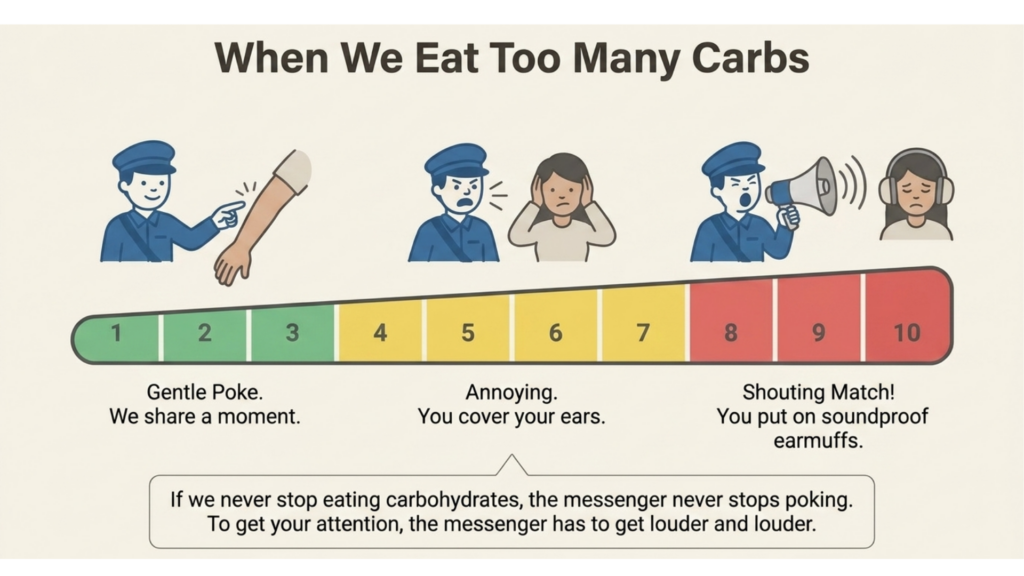
Now that we have the basic idea in place, I’m going to take a step back, and go back to that shouting match I was talking about.
Let’s say I wanted to tell you something important.
I might poke you in the arm to get your attention, and so when I poke you maybe on the shoulder, you’d probably turn to me and say, “What’s up?”
And I tell you what I wanted to say.
We probably would share a moment, maybe a laugh, and then I’d stop poking you and we’re done.
So next time if I was to poke you again, you kind of trust me that there must be something on my mind that I wanna tell you, maybe a funny joke, maybe something important.
And so you would turn to me and ask me, “what’s up” again, and I would let you know.
Now, let’s say I keep poking you and I’m poking you more frequently, and I’m telling you almost the same thing as before.
There’s been no change, no real difference in what I have to tell you, but I’m poking you more often to tell you more often.
Eventually you’re going to be annoyed.
At first, you’re going to look at me weird and be like, “Okay, yeah, you told me that already, and what?” And then eventually you’re gonna start ignoring me.
Even so, I still want to tell you what I have to tell you.
So I’m going to try to get your attention again by poking you a little harder.
Finally you turn to me and I tell you the same exact thing.
And of course you’re annoyed because nothing new has changed.
So even though now I’m poking you a little harder than before, you’re going to start ignoring me again.
Now I have to up the anti.
Maybe I lightly shove you in the shoulder or I speak a little louder.
So you decide to cover your ears with your hands.
Then I try to start shouting. So you put in some earplugs.
Then I go grab a megaphone. Then you put on those noise cancelling earmuffs that landscaping people wear.
Then I go get a microphone attached to speakers that are 100 amps. Then you go sit in a noise cancelling soundproof room.
And on and on it goes until I burn out or you figure out a way to not hear anything at all.
Which is the death of both of us.
Because I’ve burnt out. I’m exhausted. I have no other way of getting the message to you or yelling it louder to you.
And you have no way of receiving any message whatsoever, even if it is truly important to your survival.
How This Plays Out Inside Your Cells
So basically this is kind of what happens with insulin resistance.
There is sugar in the bloodstream and that sugar is vital for the cell to perform its function.
The only way to get that sugar into the cell is through the use of insulin.
So the cell kind of does the same thing normally.
If insulin comes and knocks on the door, the cell asks who is it?
The insulin says, “special delivery.”
And so the cell opens the door and lets the sugar in.
Then it closes the door and the insulin goes away.
But if insulin is constantly there knocking on the door, the cell adapts to its environment.
It doesn’t like to be stimulated that much, so it starts to ignore the door.
Pretty soon, insulin is ringing the doorbell to get attention.
And it might work for a little bit, but soon the cell is going to rip off that doorbell because they’re so annoyed with it.
Then there’s going to be even more insulin banging down the door.
Well, now the cell is gonna start to build up barricades.
And on and on it goes until it’s impossible to send any more insulin because the pancreas burned out.
And it’s impossible for the cell to receive vital information because they’ve built up a fortress so large that it essentially blocks them from getting anything useful at all from its surrounding environment.
And as a result, it basically starves itself to death.
So various people with diabetes have various levels of insulin resistance.
And as far as I can tell, that seems to be why some people might be able to eat a piece of toast and get a small spike in their blood sugar versus someone else who can have that exact same piece of toast and get a huge spike in their blood sugar.
So to me it looks like at the base of it, there are really two factors involved:
- One is how much insulin can be produced,
- and the other is whether or not your cells are willing to receive that information.
- Whether or not they’re able to do it anymore because of how much they fortified themselves against that noise.
How Do You Reverse This?
So the next question is how do you reverse this?
As you might have guessed, you have to stop the shouting.
You cannot force the cell to open its door.
Not only that, but you have to convince the cell that the shouting has gone away.
Because they may have barricaded themselves so well that they’re no longer able to tell the difference anyway.
They already got rid of the sound. But in the meantime, they’re starving.
So they want to hear the sound again, but only when it’s important.
But, you know, sometimes they’re so shut in that they can’t even trust themselves to do that anymore.
The Bunker Story
I don’t remember the story exactly, but it kind of reminds me of the guy who basically lived in a bunker for 20+ years because of the whole Y2K issue.
And finally he had to come out of his bunker because I think he ran out of food.
So I believe he was trying to scavenge and see what the world looked like.
And I kinda wonder if he had a TV or a radio in his bunker, he might have been able to actually tune in and see what’s going on with the world long before he finally came out.
So that way he can realize that everything is just fine.
So essentially we don’t want to take it to that extreme.
We want to figure out how to stop the shouting match.
And we want to signal to the cell that everything is coming back to normal.
It might not be normal yet and it may never actually be normal like it used to be.
But at least we need to let it know that we’re on the road to establishing that new baseline again.
So you stop the shouting, you limit your carbohydrate intake, and by limiting your carbohydrate intake you limit the insulin needed.
The Four Factors With the Best Support
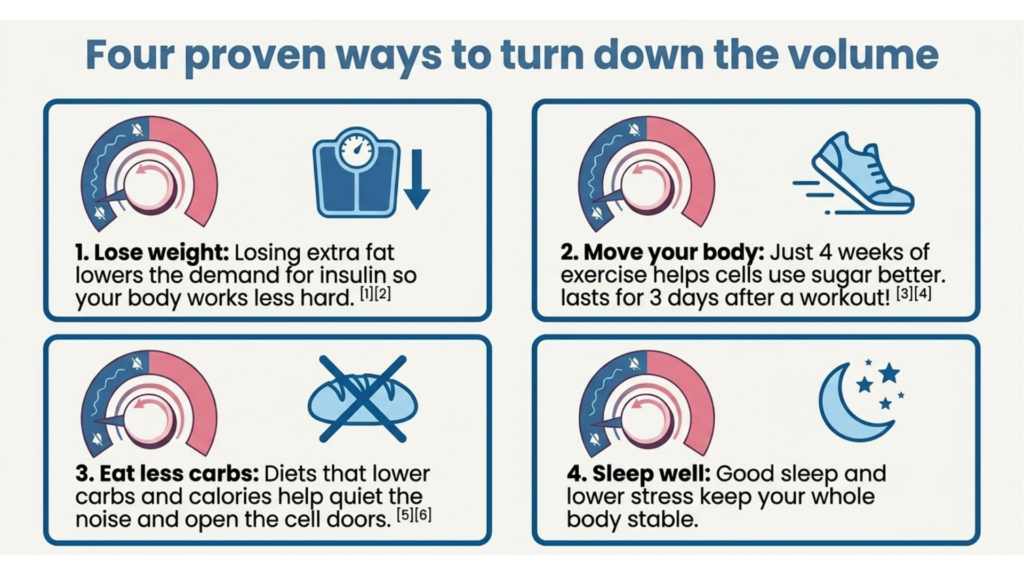
So the factors with the best support are usually the boring ones:
- You have to lose excess body fat if you have it.
- You have to exercise regularly
- You have to use a diet pattern you can sustain for long enough to keep the weight off and to keep the insulin levels down.
Now, of course there are exceptions.
I’ve seen plenty of people who have diabetes and they have no weight to lose, they exercise regularly, they eat a clean diet and they have perfect sleep hygiene.
However, according to research, these are the top four things you can do to dial it in before you try to tweak with other possible issues.
So as far as the shortest practical list goes:
1. Lose Visceral Fat
You need to lose visceral fat, which is the belly fat that a lot of people talk about.
2. Move Consistently
You need to walk or train consistently at least 30 to 45 minutes per day.
3. Eat to Support Weight Loss
You need to eat in a way that supports the weight loss and also helps to lower the insulin levels.
4. Sleep Well
And you need to sleep well enough because everybody likes to talk about cortisol as the stress hormone, and that increases your sugar levels. And of course whenever your sugar levels go up, your insulin levels are gonna go up. So you need to make sure you get your sleep dialed in.
Why This Has to Be Done Carefully
So this kind of gets tricky because if you’re far enough down the path of insulin resistance, you still ironically need to take insulin to survive.
Many people need insulin.
Many people are prescribed insulin.
So basically what we’re doing is we’re trying to shout even louder at the cells to make them do what they’re supposed to do, which is to accept the sugar.
So in a way, we kind of set up a vicious cycle where essentially we’re encouraging the cells to kind of barricade themselves.
So basically we’re in a catch 22 where we have to pick the lesser of two evils.
We can either let the sugars run rampant in the bloodstream and therefore we cause all kinds of cardiovascular issues like heart attacks and strokes and kidney failure and all of that.
Or we can try to make sure that that blood sugar gets where it needs to be.
But at the same time, the cells themselves are basically sick of it.
So basically what I’m trying to get at is that there’s a fine line between what needs to be done to survive and what needs to be done to avoid complications.
So your doctor definitely needs to monitor your progress as you go through this.
You can’t just one day decide to stop insulin, stop all your medications, go on a keto diet and expect everything to be perfectly fine and things will take care of themselves.
You can’t do that.
You have to slowly gradually do this and you have to be monitored all along the way in order to make sure that you don’t, ironically, have a hypoglycemic episode even though your blood sugars are in the range of two or three hundred.
The Questions to Bring to Your Doctor
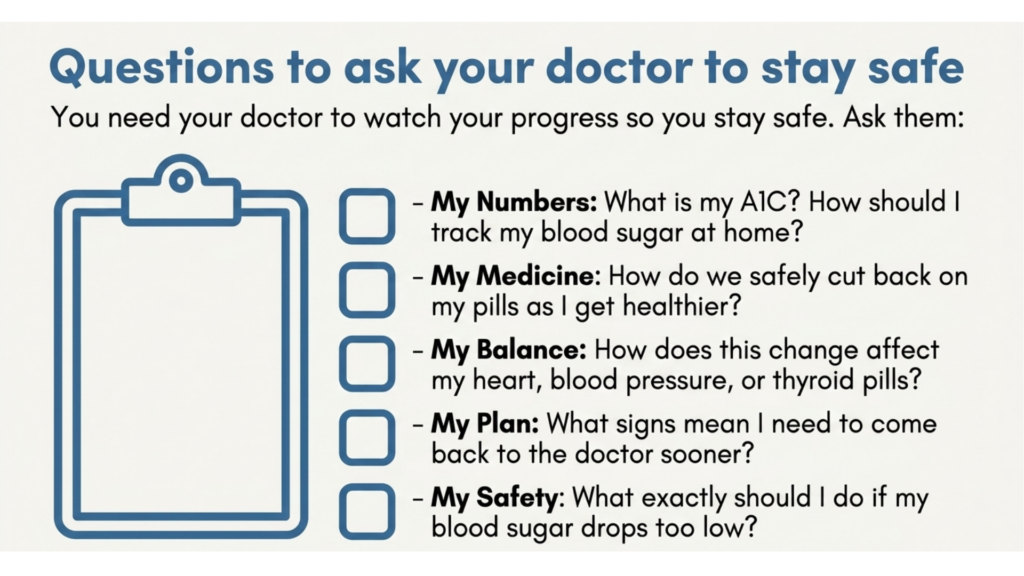
So based on what we’ve learned, how do you bring this forward to your doctor?
When you go to the doctor, you need to have a set of questions in hand because this is impacting your life.
This is impacting how you show up in the world.
- This is causing you fatigue
- Causing you lack of focus
- Causing lost time with your kids
- Lost productivity at work
- Even if you’re producing enough for your family, how much more could you be doing?
So this set of questions is not just a matter of:
- How do you reverse insulin resistance.
- It’s not just how do you cut medications out of your life so you don’t have to pay for them anymore.
- It’s not just how do I eat the foods that I love eating and go back to my normal life where essentially nothing has changed.
This is a set of questions designed to help you work with your healthcare team, and you’re going to have to work with the healthcare system.
The healthcare system tends to favor medication and the food pyramid, and I hear a lot of angst regarding that.
However, it is a place to start.
And frankly, you would need your primary care provider to monitor your progress and make sure things are on the right track.
Because if you go too fast it could be just as bad as if you go too slow, or even worse.
Because like we were saying before,
Hypoglycemia is more dangerous than hyperglycemia. Which is to say that low blood sugars is probably more dangerous than high blood sugars.
So what are the set of questions that you need? You can begin to start asking questions.
1. Where Do You Stand?
What is your A1C? What does your blood sugar log show you?
2. How Are You Going to Track Your Progress?
What is the easiest method? You’re going to have to take meticulous notes.
3. What Medications Are You Currently Taking?
Are you taking them correctly? How can you begin to cut back on the medications? What signs are required to show that you don’t need as high a dose anymore, and therefore you can begin rolling that back?
4. What Medications Are You Taking for Other Chronic Conditions?
So if you have hypertension, if you have high cholesterol, if you have low thyroid issues, how does that play a role in what’s going on with you?
Because you can’t just stop taking blood pressure medications, you can’t just stop taking cholesterol medications, nor can you stop taking thyroid medications.
So all of these need to be in balance and progressively helping you move towards a healthier state of being.
5. How Frequently Do You Need to Check In?
How many times do you need to come back to the doctor? What should you do at home to monitor?
6. What Are the Signs and Symptoms That Should Bring You Back Sooner?
7. How Do You Know You’re Moving in the Right Direction?
8. What Do You Do When You Get Off Track?
How do you jump back on the bandwagon? It’s fine to jump off as long as you catch the next one.
9. What Do You Do If You Have a Hypoglycemic Episode?
10. What Are You Aiming to Accomplish? What Is Your Goal?
The doctor’s goal is your A1C and control of diabetes, but what is your goal?
How does a lower A1C and better control of diabetes going to improve your life?
Is it gonna give you more energy, more patience with your kids, more focus at work?
How does this help you show up as the person you want to be in your life?
Beyond the Doctor’s Office
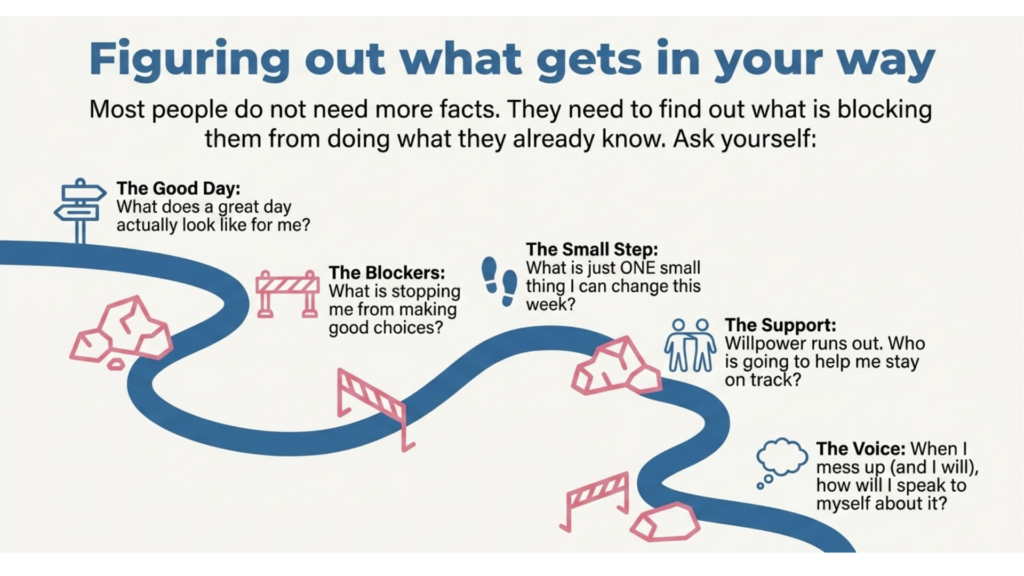
And that’s where the questions have to go somewhere your doctor doesn’t always have time to go with you, because now you need to ask yourself, what does a good day actually look like for you?
1. What Does a Good Day Actually Look Like?
And I’m not just talking about labs, I’m talking about your day. What are you doing? How do you feel? Who are you with?
2. What’s Actually Getting in Your Way?
What’s actually getting in the way of you doing what you already know you should be doing?
Because most people don’t need more information.
We already know:
- That we have to clean up our diets.
- We already know that we have to exercise more and go for walks.
- We already know that we need to sleep better.
That’s fine. But we need to figure out what’s blocking us from using the information that we already have.
We need to figure out what’s getting in our way.
3. What’s One Small Thing You Could Do Differently This Week?
And then once we figure that out, we need to ask ourselves, what’s one small thing we could do differently this week?
We’re not looking for an overhaul.
We’re not looking to be perfect.
Just one thing in a week that would move you closer to that day that you just described.
4. Who’s Going to Help You Stay Accountable?
And who’s going to help you stay accountable to that?
Because as we all know, willpower runs out.
So who can we turn to for support?
And oftentimes the answer is not always easy.
We can’t always turn to our families, unfortunately.
There are many times where basically the family is the reason that we ended up with the conditions that we have:
- Stressed out
- burned out
- shouting match at home
Sounds familiar.
And this goes on on a cellular level too.
5. How Do You Talk to Yourself When You Get Off Track?
So we need to figure out who can be our support.
Because when you get off track, how do you wanna talk to yourself about it?
The way you talk to yourself after a setback determines whether you get back up in a day or in six months.
Oftentimes, in my personal experience, that voice in my head is the most detrimental voice that I can listen to, and having that outside support helps.
Full disclosure, I do not have diabetes personally.
And so far as I know, I don’t have insulin resistance.
However, we don’t need to talk about clinical stuff here.
This is a common issue with family, with loved ones, kids, relationships of all kinds including the relationship to yourself.
And so that voice in your head can be your best friend or your worst enemy.
And it seems to me that there’s a lot of good information coming out recently, a lot of good messaging coming out recently that it’s okay to need to talk to someone during your low times.
And I see it all the time on different messaging boards, different social media outlets.
And my only piece of advice there would be to be careful who you listen to, because if you open yourself up to social media, everybody and their aunt and their uncle and their whoever can tell you one thing or another.
But picking the right people, picking the right support matters most of all.
And that’s why it matters to get your healthcare team in alignment.
It’s not just your doctor.
It’s your dietitian.
It’s your endocrinologist.
And that’s just on the clinical side of things.
It can be a trusted friend, your spouse, your mom, or your dad who has also been going through this.
Having support matters.
And I think that’s the difference between managing a diagnosis and actually getting your life back.
Your Goal Is Bigger Than a Number
So think about what is your real goal, and then realize that your goal is actually bigger than that.
Your goal is not simply to have more energy.
It’s to show up in the world more authentically.
And something like this helps you be that person even in your time of struggle.
So stop the shouting, take a step back, open your ears, and now that you’ve had this experience, you can do it with better awareness of who you are.
So that’s it for today. Thanks for reading, and we’ll see you in the next one.
If you want to go deeper on the research behind insulin resistance for your own situation, a Diagnosis Clarity Brief gives you a plain-English summary built around your specific questions.
Health and Wellness coaching
Would it be a bad idea to work together now?
If You’re Not Ready Yet, That’s OK.

References
Yes — these are the six to keep.
- Vazquez Arreola E, Knowler WC, Hanson R. Weight loss, lifestyle intervention, and metformin affect longitudinal relationship of insulin secretion and sensitivity. J Clin Endocrinol Metab. 2022. https://doi.org/10.1210/clinem/dgac509
- Rebello CJ, Zhang D, Kirwan JP, et al. Effect of exercise training on insulin-stimulated glucose disposal: a systematic review and meta-analysis of randomized controlled trials. Int J Obes (Lond). 2023. https://doi.org/10.1038/s41366-023-01283-8
- Way K, Hackett D, Baker M, Johnson N. The effect of regular exercise on insulin sensitivity in type 2 diabetes mellitus: a systematic review and meta-analysis. Diabetes Metab J. 2016;40(4):253-269. https://doi.org/10.4093/dmj.2016.40.4.253
- Mason C, Foster-Schubert KE, Imayama I, et al. Dietary weight-loss and exercise effects on insulin resistance in postmenopausal women. Am J Prev Med. 2011;41(1):1-9. https://doi.org/10.1016/j.amepre.2011.06.042
- Iglesies-Grau J, et al. Metabolic Improvements and Remission of Prediabetes and Type 2 Diabetes: Results From a Multidomain Lifestyle Intervention Clinic. Can J Diabetes. 2022. https://doi.org/10.1016/j.jcjd.2022.10.010
- Rybak D, Krupa O, Furtak K, et al. The role of lifestyle in the prevention and treatment of insulin resistance: a review of clinical and intervention studies. Quality in Sport. 2025. https://doi.org/10.12775/qs.2025.37.57731