
Why Is My Blood Sugar High In The Morning But Normal All Day?
The number that will not move
So you wake up in the morning, and before you’ve done anything else, you check your blood sugar. And there it is again. You see a score of a hundred and thirty-five, maybe 140, or whatever you typically see in the morning.
And the thing is, you’ve done everything. You changed the way you eat. Maybe you quit drinking, you quit smoking. You started exercising regularly and you’ve actually been keeping up with your regimen. And every other reading you take all day long seems fine. You hit your target range all the time.
It’s just that one reading in the morning, every day.
So that can be frustrating.
What I’d like to do today is explain why that happens, and why it turns out to be the number that your medication has the hardest time moving. And then I want to help you work out whether your reading is actually an issue – because for a lot of you it isn’t. And that’s a discussion to have with your doctor.
Where I’m sitting
Before I get into all of that, I do want to be honest about where I’m sitting. I’m not your doctor. I went to medical school, and these days I manage a primary care clinic.
So what I see isn’t really the exam room from the inside. However, I see everything that goes on around it – all of the appointments that got made and which ones did not get made, what questions never got asked, what somebody understood by the time they got back out to their car in the parking lot.
That’s the gap I’m talking to you from. And I think a lot of this problem actually lives in that gap.
The man who stopped his metformin
I want to start with a man I read about, because he was exactly in this position. Same numbers, same frustration.
He’d been given metformin a couple of years earlier. And he watched that morning number, and it did not move. So he stopped taking it.
Now, I don’t think he was being reckless. I think he made a reasonable decision.
And the issue with reasonable decisions is that they’re reasonable according to the information we currently have. That’s all any of us gets to work with.
This man seems smart. He was motivated. He did his homework – you don’t just quit smoking and start exercising regularly by accident. Those are all real strengths and they deserve to be celebrated.
But reason is limited to the knowledge that we have. And the piece he was missing changes the whole picture.
What your liver is doing while you sleep
Let me tell you what’s actually happening overnight, because sometimes we need a clearer explanation of what’s going on before we can figure out what to do.
Right now, in your bloodstream, there’s about a teaspoon of sugar – which is roughly four or five grams. And at rest, your body burns through roughly 8 grams of sugar per hour.
So if you do that math, the sugar that is currently in your blood right now, on its own, would last you about half an hour.
Which raises the question. Why aren’t we eating something every half an hour? Why don’t we die every night in our sleep?
Well, because our bodies have this genuinely amazing mechanism for keeping our blood sugar steady.
If our blood sugar goes high, we have hormones to bring it back down – and that’s usually the one that everybody keeps hearing about, so we take insulin. If our blood sugar dips, we’ve got hormones to bring it back up. So that’s usually glucagon.
And then towards the end of the sleep cycle, cortisol tends to also take some sort of effect, because we’re about to wake up and we need blood sugar available for our muscles so that we can get up and start moving.
So while you’re sleeping, your liver is kind of acting like a silo. It stores the surplus of glucose, and then over the course of the night it slowly releases it into your bloodstream – so that you don’t have to constantly wake up every half an hour to eat something.
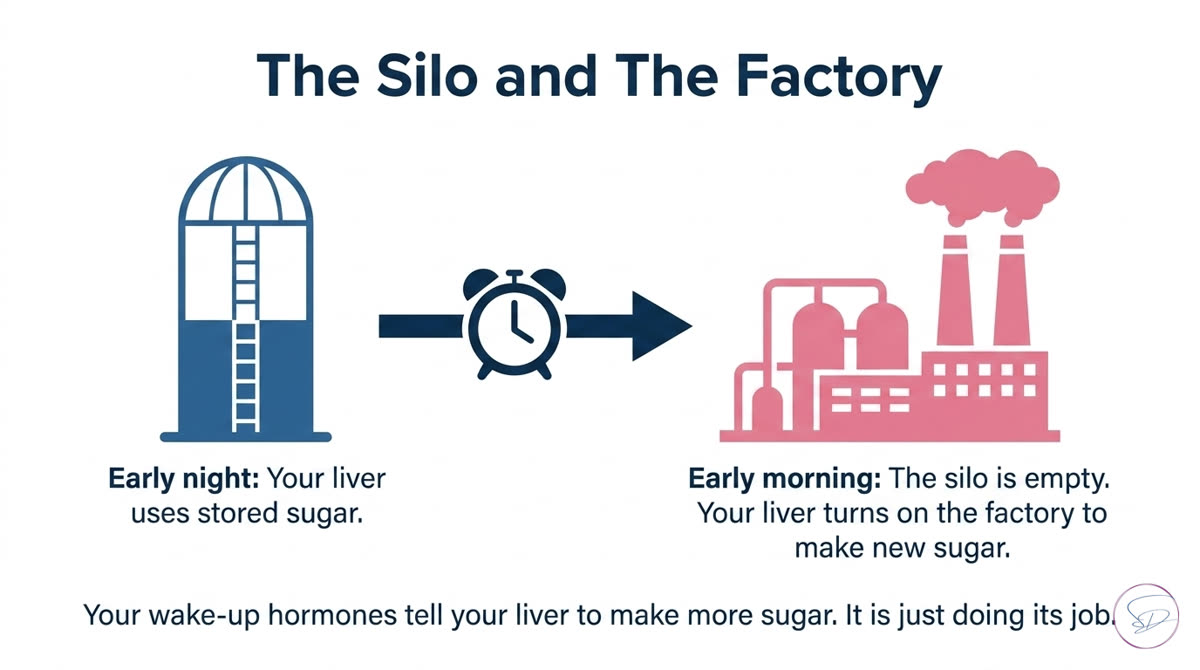
By the time you reach the morning, the silo is practically empty. So your liver starts making sugar from scratch.
And so we see that spike of blood sugar in the morning even though we haven’t eaten anything.
When researchers actually measured this, they found that in people with type 2 diabetes, glucose production climbed steadily all night long – but not in people without diabetes.1
So that number you’re staring at at six in the morning, or whenever you wake up: you didn’t necessarily do anything to cause that. Your liver actually made it, because it’s doing its job to keep you alive.
You are not failing
And this is the interesting part that I didn’t really know before I looked it up.
This happens to about half of people with diabetes. So about one in two people.2
And it doesn’t seem like anybody really knows why, or what causes it, or even how to target that directly.
So I went to dig a little bit more. And it looks like we don’t necessarily have any recent systematic reviews – which are research papers that kind of summarise everything that we already know about a particular topic.
I’m telling you this because you may have quietly decided that you’re the one failing at this. It’s very easy to blame ourselves, and to avoid or ignore what we’re not good at.
But I do want to tell you: you’re not failing. You’re dealing with something that half of people with diabetes are dealing with, and the medical field hasn’t fully worked it out yet.
So does this number actually matter?
With that said – does this number actually matter? Should you be worried about it?
The honest answer is that it depends. So let’s figure out how to work out if you need to be worried or not.
The blood sugar level you see first thing in the morning actually does very little for your A1c. It’s about four tenths of a percent. And it seems that none of the medications you take by mouth will get rid of that.3
So when this man was judging his metformin by his morning number, he was grading it on a test it was never going to pass. It’s almost like testing a fish on how well it can climb a tree. It makes no sense.
But I want to be careful here, because it’s easy to take that too far in the opposite direction. Your fasting number itself is a different thing from that morning bump. And your fasting number is not small.
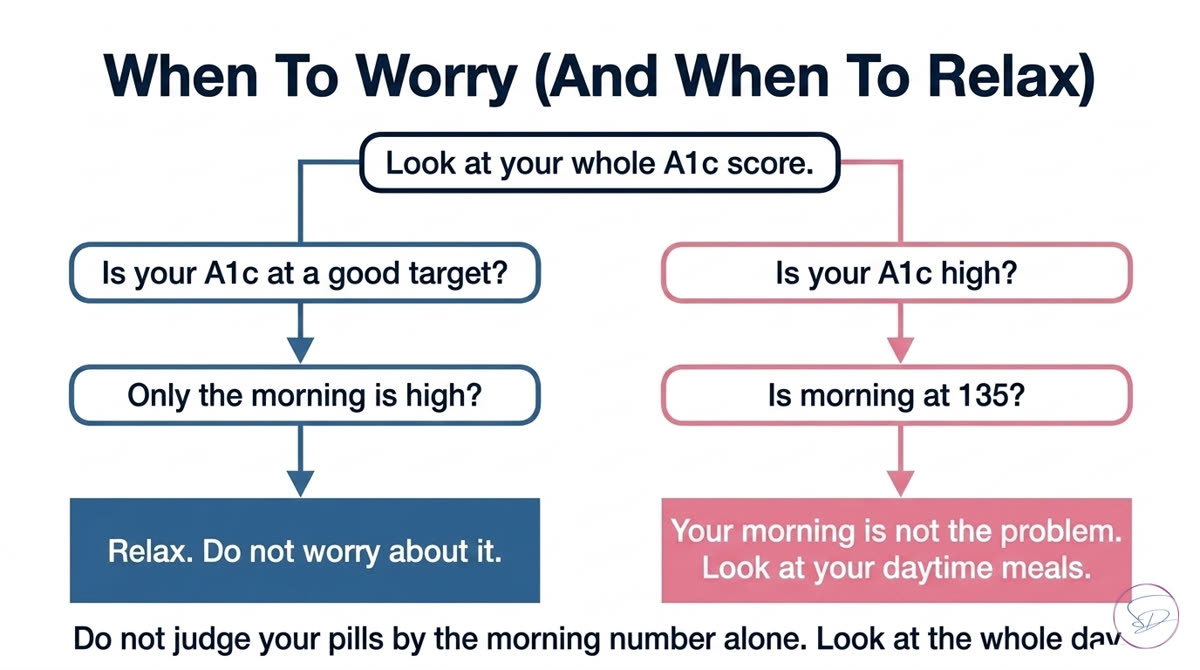
For people who have a well-controlled A1c – which is usually less than seven – the fasting sugars only contribute about 30% to that A1c number.4 So most of that A1c number is coming from meals that are eaten throughout the day.
However, people with a higher A1c, that’s above seven – this actually flips, where the fasting glucose contributes about 80% to that A1c number.5
So it really comes back to your actual numbers, and what’s going on throughout the day.
If your A1c is on target and the only number that’s high is the one in the morning, then I’d probably say you don’t have much to worry about.
But if your A1c is high, that’s a different conversation. Because if your A1c is high and your morning number is only sitting at 135, then your fasting sugar levels are not driving that A1c. We actually have to see what’s going on throughout the rest of the day to cause that high A1c.
And that’s where you and your doctor should be looking. Not your morning time reading. That’s where you and your doctor can open a discussion.
A stranger gave him good advice
Now, something jumped out at me in that thread that I want to highlight.
A stranger replied to this person. And he or she was really good – they genuinely tried to help, and asked probably the single best question anybody can ask, which was: which metformin were you on, and when were you taking it?
And then he suggested taking the whole daily dose in the evening, and switching over to the extended-release version. The logic was to take the medication before you go to bed, and then you’ll see a more controlled number in the morning when you wake up.
Now that is a real principle. So it is something to consider. We can probably apply it to something like insulin, where you adjust the dose against the fasting number.6
However, it just isn’t how metformin works. And when researchers put together nine different trials with more than two and a half thousand people in them, it turned out that the extended release wasn’t really that much better than regular metformin for blood sugar. And if anything, it was just slightly worse.7
So this person had a good idea. It was just applied to the wrong medication.
And that’s not to say the man was foolish. And it’s not to say he shouldn’t have spoken up. It simply recognises that this is exactly the sort of thing where you need somebody with training to catch it.
Not because you’re not smart. Not because you wouldn’t know and be able to research things on the internet. But because knowing which principle belongs to which medication is a doctor’s expertise.
And you could probably study all of medical school on Google. But until somebody invents a search engine that lets you look up the wisdom of medicine, you’re going to have to talk to your doctor. You’re going to have to communicate with him or her, and open up that conversation.
One tree, or the whole forest
Which brings me around to what I want to leave you with.
Let’s say you’re in charge of a forest, and you notice that one species of tree is starting to die off. Of course you’re going to look into that. What is going on? Is there an infection? Is there an invasive species? What is happening? And you should absolutely find out what’s happening.

However, you also have to keep in mind that you’re not just in charge of one species of tree. You’re in charge of a forest. You’re in charge of all the other trees, and the animals, and the mushrooms, and the bacteria that supports everything. You’re in charge of the whole ecosystem, to keep things in balance through life and death.
So your morning blood sugar is just one tree. It’s one data point.
If you widen out a bit – bigger than the morning is your blood sugar across the whole day. And bigger than that is your blood sugar across the week. Bigger than that, blood sugars across the month, and then every three months, and now you’re talking about your A1c. Bigger than that, you want to track your A1c across a year, and across a decade.
Why? Because ultimately sugar levels over decades are going to impact your kidneys, your eyes, your feet, your heart – everything. The whole ecosystem of the body.
And it goes back to a question that I think is the real question underneath all of this. It was never how do I force this one number to go down. It’s more: how do I nourish this body that I have?
How have I been nourishing it? How has it responded? And what should I be doing differently now?
It’s about balance, consistency, and adaptation. Because your body is going to need different things throughout the course of a lifetime. You’re going to need different things at 60 than you did at 40. And if you stay locked in with what worked 20 years ago and call it consistency – that might cause you problems. You’re just stuck. You’re not adapting to what you need.
If you’ve already stopped your medication
Now, if you’re watching this and you’ve already stopped your medication, I’m not here to give you a hard time about it. I’m not trying to say you should start back up right away. I’m not trying to say you should stay off of it.
I am saying that you made a reasonable decision with the information you had. However, you should also open that conversation with your doctor.
Because I do have a concern here. It’s rarely just the medication.
Today you might decide, oh, I’m just going to stop this one pill, because what’s the point? It’s not helping my sugar level anyway. Then maybe your diet slips a little, because what’s the point? So my blood sugar goes up a little bit, that’s okay. And then your exercise regimen goes. And then it’s the appointment that you didn’t rebook.
I don’t think we notice how quickly one small discouragement turns into a much bigger problem. And it’s not a character flaw. It’s just part of being human.
So please don’t let this one thing quietly start off a sequence of events that causes your diabetes to slide down a slippery slope.
Remission is genuinely possible for a lot of people. However, the thing is that the damage might not be reversible. So what you can always do is protect what you’ve still got.
What to say at your appointment
So how do you do that?
You book the appointment. You bring your log – all the readings, the actual numbers, the times that you took them. And you say something like:
“Hey Doc, I’ve been taking this medication for seven months now” – or however long you’ve been taking it – “my daytime numbers are fine, my morning number won’t move, and it’s extremely frustrating. Here are my logs. What do you think we should do differently?”
And then just leave the floor open. Let your doctor talk to you. Listen to what your doctor has to say.
And you can ask these other questions throughout your conversation:
- What is my A1c right now, and is my morning number actually driving it?
- Is this dose still the right one for me, or is it time to change something? We need to know whether or not something is working for us. And sometimes we don’t know, which is why we need the doctor’s wisdom and intuition to figure out what to do next.
- Would seeing what my blood sugar does overnight, with a CGM device, tell us anything useful? This would obviously give us more granular feedback – to see whether something is actually happening overnight that is causing this, or whether it’s something from the previous day.
- What else should we be checking while we’re at it? Because your diet might be on point, your exercise might be on point, all of your medications might actually be exactly what you need. However, there could be other issues going on that are causing your A1c to go up, or your blood sugar in the morning to go up. There could be stress, there could be insufficient sleep – there could be a multitude of things. So we need to broaden our gaze in that case.
And if you notice what every one of those questions does – it opens the conversation up.
Stopping your medication on your own closes any of that off. There is no discussion. And without a discussion, there is no resolution. And that could be dangerous.
What is your vision?
Let me finish with the question I’d actually ask you if you were sitting across the table from me.
What’s your vision?
And I’m not talking about your target number. That’s your doctor’s vision. Your doctor knows that they want to see your A1c below a certain number. Why? Because they want to keep you out of the hospital, because the complications down the road are not pretty.
But what is your vision?
What does health look like to you a year from now, ten years from now? Who are you with? What are you doing with them? Is what you’re doing today serving that purpose – serving that vision?
Because you can get this right over the next year and every year after that. Your A1c can be spotless. You can have perfect morning fasting blood sugar levels. And you can do this by staying balanced and consistent, and adapting to your body’s needs over time.
However – what is driving you to look into that one tree? What’s driving you to find out what’s happening to it, and then lift your eyes up and take care of the rest of your forest?
Because that’s the part that’s actually yours to look after.
See how you want to shape your forest. See how you want to be present within it.
Sources
- Radziuk J, Pye S. Diurnal rhythm in endogenous glucose production is a major contributor to fasting hyperglycaemia in type 2 diabetes. Suprachiasmatic deficit or limit cycle behaviour? Diabetologia. 2006;49(7):1619-1628.
- Peng F, Li X, Xiao F, Zhao R, Sun Z. Circadian clock, diurnal glucose metabolic rhythm, and dawn phenomenon. Trends Neurosci. 2022;45(6):471-482.
- Monnier L, Colette C, Dejager S, Owens D. Magnitude of the dawn phenomenon and its impact on the overall glucose exposure in type 2 diabetes: is this of concern? Diabetes Care. 2013;36(12):4057-4062.
- Monnier L, Lapinski H, Colette C. Contributions of fasting and postprandial plasma glucose increments to the overall diurnal hyperglycemia of type 2 diabetic patients: variations with increasing levels of HbA1c. Diabetes Care. 2003;26(3):881-885.
- Riddle M, Umpierrez G, DiGenio A, Zhou R, Rosenstock J. Contributions of basal and postprandial hyperglycemia over a wide range of A1C levels before and after treatment intensification in type 2 diabetes. Diabetes Care. 2011;34(12):2508-2514.
- Riddle MC. The Treat-to-Target Trial and related studies. Endocr Pract. 2006;12 Suppl 1:71-79.
- Abrilla AA, Pajes ANNI, Jimeno CA. Metformin extended-release versus metformin immediate-release for adults with type 2 diabetes mellitus: a systematic review and meta-analysis of randomized controlled trials. Diabetes Res Clin Pract. 2021;178:108824.
I do help people work through this – understanding what’s going on at a medical level and at a personal level. If you need a little help with that, take a look at the Diagnosis Clarity Brief.