Is Type 2 Diabetes a Moral Failing (It’s Not Your Fault)
Do people with type 2 diabetes have fake diabetes?
I was reading an online forum and someone with type 2 diabetes had posted that their friend who has type 1 diabetes called them a fake diabetic.
The idea being that if they had exercised properly and dieted properly, they would not have type 2 diabetes.
Versus if you have type 1 diabetes, you basically can’t really do anything to control it.
It just happens.
And honestly, years ago, part of me would agree to a limited extent.
However, there are many people out there that do everything right from the beginning and still develop type 2 diabetes.
They’re aware of their family history. They eat right. They exercise daily.
And still they somehow develop the disease.
So today I want to talk about why that belief exists, why it’s wrong, and how to understand diabetes a little more deeply so that you can ask your doctor questions to help navigate your care a little better.
A Story From Medical School: How Bias Sneaks In
When I was a medical student and my team was on call, we got a code blue.
We rushed to the ICU because someone was having a heart attack.
When we got there, the room was already full.
There were a lot of people already working on her, doing CPR, administering medications, everything they had.
Mind you, I’ve never seen this patient before.
I knew nothing about her.
But I took one look at the scene and I immediately made some judgments:
- She was in the ICU.
- She was morbidly obese.
And two thoughts checked off in my head practically automatically.
So, it’s almost like, “Oh yeah, of course she’s here. Of course she’s having a heart attack. Like, this makes perfect sense.”
Unfortunately, they couldn’t save her.
And even though I felt bad, I still noticed that flicker of judgment underneath; that if she made different choices throughout her life, she wouldn’t have been in that bed and she wouldn’t have gotten to this final point.
Even Medical Professionals Are Not Immune to This Bias
So, it’s very bizarre because supposedly I’m being trained to be objective, to follow the evidence, and yet the bias was real.
And even though that happened many years ago, and that bias is still with me to a degree, I’ve become less certain that suffering is that simple.
So when I read that comment, it’s not necessarily a prejudice between friends or family or strangers.
Even medical professionals make this mistake.
And even that person also noted that health care workers, nurses, doctors, people who studied this and took the time to really dive deep in order to help people, still seem to develop this bias from what I’ve seen.
Why Do We Reach for Blame?
And I have to ask the question, why do we do that?
Because there’s nothing in our textbooks that actually says we should have this bias anywhere.
Why do we look at a sick person and try to reach for an explanation that involves their choices?
Why do we judge people for the decisions that they make?
And in my opinion, I like to think that if I make the right choices for myself, then everything will be all right.
Randomness is pretty scary.
So if a disease can happen to a perfectly healthy person, then what’s the point of doing the right thing all the time?
Because the idea that we can protect ourselves by doing everything right doesn’t feel like it’s on solid ground anymore.
And that’s kind of uncomfortable.
So, I’m thinking that we construct a story so that we can kind of delude ourselves that illness is usually earned.
That people who get sick made choices that actually led them there.
And in that way, we feel in control again.
We feel safe.
We want to know for certain that when we make good choices, life will reward us for those decisions.
And if we make bad choices, life will essentially punish us for those decisions.
Even though that kind of thinking is deeply human, unfortunately, it’s not so black and white in the real world.
It’s just wrong.
And it causes real harm to people who are already dealing with something hard enough.
The healthiest person in the room can still get sick and the sickest person in the room still deserves dignity.
The Biology of Type 2 Diabetes
So, let’s try to put our judgment aside for a moment and actually look at the biology of the issue.
The Genetic Component Is Stronger Than Most People Realize
There seems to be a strong genetic component to this disease.
So if one twin gets type 2 diabetes, the other twin approximately has a 70% chance of also
developing the disease, even if they’re living completely different lives.
So because it’s not 100% guaranteed, there is a little wiggle room.
And with that wiggle room, you have some semblance of control so that diet and exercise can influence your risk.
And I think this is where I make this mistake because I believe that if I:
- Eat right,
- Exercise,
- Watch what I do for my health,
Then that would somehow translate into 0% chance.
Influence is not the same as control and risk is not the same as cause.
So a poor diet does not necessarily cause diabetes or a healthy diet does not necessarily eliminate or prevent diabetes.
It seems to be all about balance, managing your risk and influencing where you can.
And so you can shift the balance one way or the other.
What Shifts the Balance Toward Health
- Eating a healthy nutritious diet and by
- exercising.
What Shifts the Balance Toward Diabetes
- Eating a poor diet,
- by lack of exercise,
- or even having something going on such as an infection,
- taking certain medications,
- or even pregnancy that can shift the balance towards diabetes in this case.
And the greatest frustration for me is noticing how people can appear to be healthy but are not.
And other people can appear unhealthy, but they are.
And the best explanation I have for that right now is to figure out where your balance is.
Because taking care of yourself certainly influences your probability of health, but it doesn’t guarantee the outcome.
You do it because it shifts the odds in your favor, not because it makes you immune.
So your doctor may recommend lifestyle changes for you, and that is important to do because your level of risk is not your destiny and disease is not proof of moral failure.
Type 1 vs Type 2: Two Completely Different Diseases
So what is diabetes?
And I believe this is another folly because we have to pay attention to the character of the disease.
And both of them essentially have the same result which is high blood sugar.
But we get there for two completely different reasons.
Type 1 Diabetes
In type 1 diabetes, the immune system basically destroys specific cells in the pancreas.
Those cells produce insulin.
If there’s no insulin, the blood sugar rises.
Type 2 Diabetes
In type 2 diabetes, the pancreas can still produce insulin, but the cells of the body stop responding to it.
And so you develop insulin resistance.
The pancreas would try to compensate by making more, but over time it just can’t keep up and blood sugar continues to rise.
So there are two different causes with what appears to be the same result.
Latent Autoimmune Diabetes in Adults (LADA)
And with latent autoimmune diabetes in adults, it seems like it’s a combination of the two.
It just takes a lot longer.
So, a lot of people are mistakenly diagnosed with type 2 diabetes because it progresses very slowly, sometimes over many years.
And so, that can be a problem and lead to some serious consequences because if you’re not getting the appropriate medications and checking your blood work appropriately, then you could end up having a crisis in the hospital even if you may have been able to prevent it.
So, if you were diagnosed with type 2 diabetes and you seem to be doing everything right, but your numbers keep getting worse despite your real effort, that may be a conversation worth having with your doctor.
Questions to Ask Your Doctor
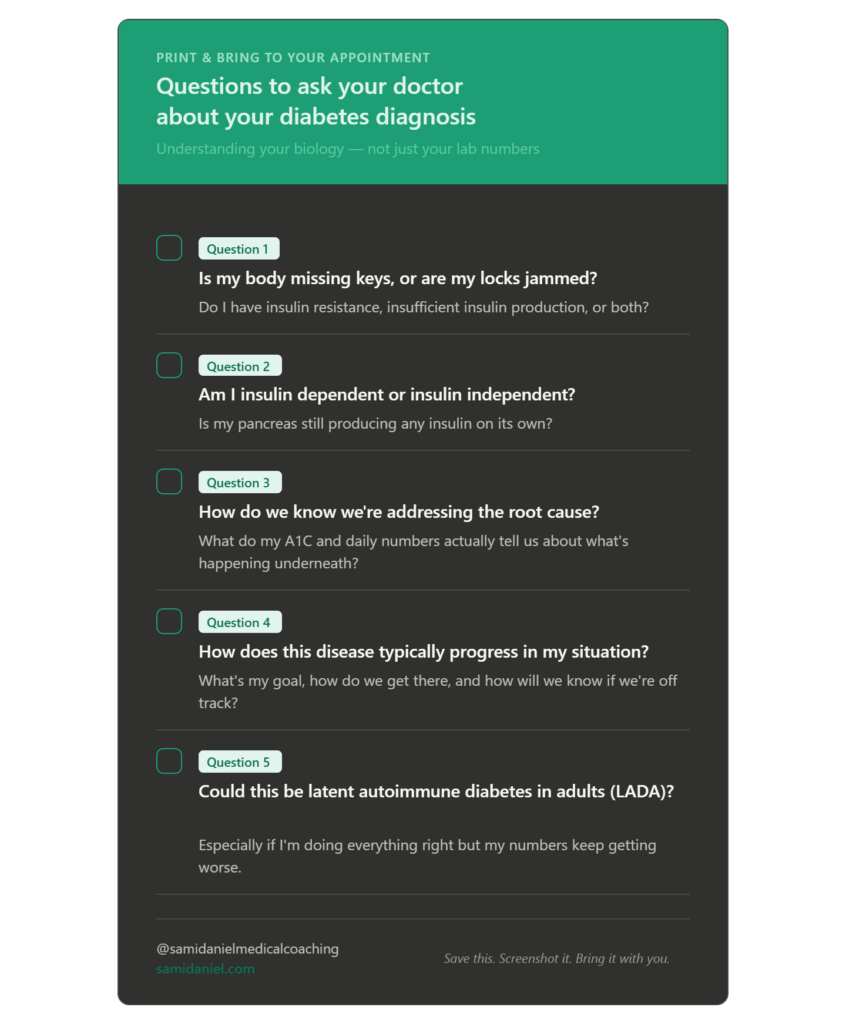
So, how do you approach the topic?
If you have been diagnosed with diabetes and it does not matter what type, the goal is not to feel ashamed.
The goal is to understand what’s going on with your body and how is it functioning at the present moment.
The reason being that understanding makes you aware of your options.
And the most useful questions to ask your doctor aren’t about what you did or didn’t do.
They’re about the mechanism.
What’s actually happening in your body that leads to the number you read every morning on your glucometer.
So, how do we get to that understanding?
We can ask some questions like,
“Is my body missing keys or are my locks jammed?”
If you want to put it in doctor speak, basically the question is:
- “Do I have insulin resistance or insufficient insulin production?”
- “Am I insulin dependent or insulin independent?”
Because a person with insulin dependence means that they’re not producing any insulin at all.
So, they have to inject themselves.
A person who’s insulin independent means that they’re still producing insulin and they may still need to inject themselves with insulin, but at least their pancreas is producing some level of insulin.
And this helps us figure out what type of diabetes might be present in the body.
So this tells you what’s actually happening and not just what the lab says.
The next question is:
“How do we know if we’re addressing the root cause?”
Because checking your blood sugar levels every day is like taking a picture every day.
You don’t necessarily know what happened before or after the picture.
If you check your A1C levels every 3 months, it’s like watching a movie for the last 3 months, but you don’t necessarily know the details throughout that time.
So we want to make sure that we truly appreciate what those numbers are telling us by understanding from the doctor, what’s actually happening under the hood.
Another question that would be useful is to figure out:
How this disease progresses especially in your unique situation.
Because everyone has different conditions that might complicate the issue or make things simpler.
So getting clear on the path makes your conversation with the doctor a lot more strategic because you need to know what your goal is.
How are you going to get there and how do you know if you’re off course?
Could this be LADA?
Another great question to consider is whether or not this can be latent autoimmune diabetes in adults.
And you may consider that if you’ve been treating type 2, and it just seems to be getting worse, and/or you might have a family history that you know about.
The real purpose of this question is to think outside of the box and look for other potential causes that might not fit neatly.
And if you open that door, you expand your awareness to the other possibilities that need to be addressed and again influence that balance in your favor.
The Bottom Line: Sickness Is Not a Character Flaw
So remember that person who was called a fake diabetic did everything right?
We don’t necessarily know why they still developed type 2 diabetes.
So sickness is not a character flaw.
It is biology.
And anyone dealing with any diagnosis, it doesn’t have to be diabetes, deserve care that sees the person and not the verdict.
When you understand what’s driving your body’s biology, you can start to ask better questions.
And obviously that leads to better conversations.
That’s where the real care actually starts.
So, thank you for reading.
I hope this helped.
And if you know somebody who needs to hear this, please share it with them.
If you have any questions, please put them in the comments.
I’ll read everyone and do my best to respond.
If you want help understanding your specific diagnosis and preparing for your next appointment, I work with people one-on-one.
So, please click below to learn more.
Thank you again for reading.
If you want to understand what the research actually says about your own diagnosis, a Diagnosis Clarity Brief gives you a plain-English summary built around your specific questions.
Health and Wellness coaching
Would it be a bad idea to work together now?
If You’re Not Ready Yet, That’s OK.