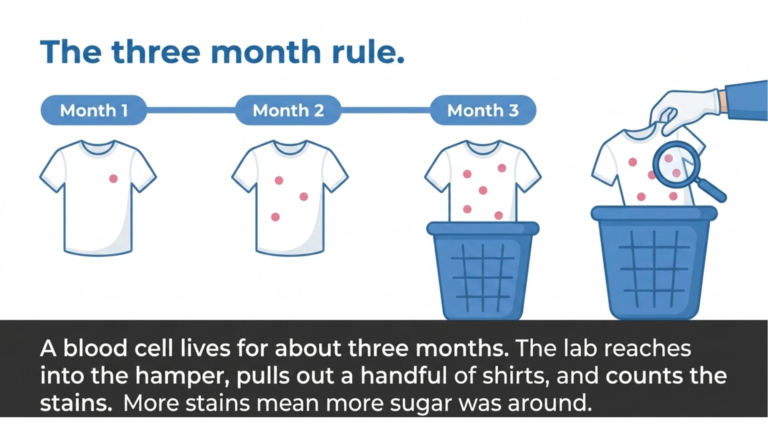
Blood Sugar Better But Your Feet Burn? What TIND Is
You did everything right
I took the medication. I changed how I ate. I started exercising. I did everything I was supposed to do. And my numbers came down.
So why do I feel worse than I did before?
If that is where you are right now, I want you to know that’s a fair question. It’s not you being ungrateful or dramatic. It is a fair question.
Because when you do everything right, something good is supposed to happen. When you do everything the doctor tells you to do, you’re supposed to feel better. That’s the unspoken deal. So when it doesn’t work out that way, it almost feels like a betrayal. Like you climbed out of a frying pan and landed in the fire.
So I want to spend some time with you today on something called treatment-induced neuropathy of diabetes. You’ll see it written as TIND. It’s something that happens to some people when blood sugars come down pretty fast after they’ve been high for a really long time.
By the time we’re done, you’re going to know what it is, when it tends to show up, what the research actually says about how fast is too fast, and three things that can go wrong quietly without ever sending you a warning signal.
Who is talking to you
Before any of that, just so you know: I am not your doctor. I am not a practicing clinician. I am a medical graduate who currently manages a primary care clinic.
So I actually see everything that goes on around your visit to the doctor’s office. All the referrals that go out. All the medications that never get picked up. All the specialist appointments that nobody books.
I’m not going to tell you what to do about your diabetes. That’s between you and your doctor. What I can tell you is what tends to fall through the cracks, and what to ask so it doesn’t fall through for you.
So I’m going to start with a couple of questions, and you don’t have to say the answer out loud.
What did you expect to feel?
What are you walking toward?
Keep those in mind, because they will give you a direction for where we’re going.
What is supposed to go right
Before we talk about what goes wrong, let me walk you through what’s supposed to go right.
Let’s say your blood sugars have been high, maybe for years. Maybe you’ve had no idea, because nothing was hurting. Everything seemed fine. There wasn’t exactly any problem.
And then something happens and you get diagnosed. And once you get diagnosed, you start getting treatment.
At that point, the treatment is often aggressive, because it might need to be. Diabetes is a nasty process. From the tip of your head to the tip of your toe, every part of you is receiving a blood supply somehow. And if it doesn’t, then that part either dies or falls away.
That’s what your doctor is trying to get ahead of. And we’re trying to get ahead of it while we’re already behind. So we have to move quickly, and most of the time that’s the best approach.
For example, there was a young man in the clinic recently, probably in his early twenties, who was newly diagnosed in the hospital. At first I thought he came in for anxiety when I saw him, because he had that deer in the headlights look. He was very overwhelmed, very nervous, not really knowing what this diagnosis would actually mean for him. He’s probably seen it in family members and understands the gravity of the situation, but he doesn’t know what he did himself to get to that level. So he put on a brave face, even though you can see the level of worry just underneath the surface.
So when your doctor moves fast, they’re not being careless with you. They are usually protecting your kidneys, your heart, your brain, your eyes, your legs. There are so many things that can get complicated because of diabetes.
But somewhere along that line, nobody really sat down with you and said: even though we’re going to treat you, it may get worse before it gets better.
So when you were in your doctor’s office — what did you actually hear? Not what you were told. What you heard. Those are different, and the difference is not your fault.
When the storm arrives
You followed the plan. And somewhere between week one and six months later — and for most people it seems to land between four to eight weeks — you start hurting. You start agonizing.1
Now, this doesn’t happen to everybody. But there are some people who, after starting treatment, start feeling burning in their feet or their legs, sometimes their hands, sometimes across the trunk or the abdomen. Nobody warns you about this, so it takes you by surprise. And some people get lightheaded when they stand up.1,2
And this is not exactly a mild thing.
There was a woman who wrote about this online. She went from an A1C of about 10 to about seven. And on paper, that’s amazing. That is great progress. We want to see that as clinicians — in fact we want to see better than that, because the goal is usually less than 7.0, and depending on your other medical conditions it can be even lower, less than 6.5.
So how is it that this woman is making great strides, great progress, and yet she’s complaining about absolute agony to anybody who will listen? Because she said that she feels like she’s being punished for doing the right thing. She used to be active. She used to be happy. And now what is happening?
If you’re somewhere in that, then you’ve probably had that thought already. Where you’re just thinking: I felt fine before. I was good. So what if my sugars were high? At least I felt okay. At least I felt active and happy.
That’s not a foolish thought. It is a reasonable response to what’s happening to you.
And notice what pain does while it is here. When it hurts like that, the pain is the only thing in the room. You’re not thinking about your kidneys. You’re not thinking about where you’ll be five years from now. You’re not thinking about what direction your life will take.
That’s not weakness. That is what pain does to all of us as human beings.
So think about what changed in your life, and when. That sounds like a simple question, but it’s not. Because if nobody connects your new pain to the change in your treatment, then it is just pain that seems to have come out of nowhere. And that’s pretty scary.
Why this happens
For a while, nobody really knew.3
Lately there seems to be some research where somebody was actually able to visualize what’s happening. Researchers were able to photograph small blood vessels around the nerve, and they found that blood was being shunted, or detoured, around where it was supposed to go. So it seems like the sugar level is not the problem. It’s more so the plumbing.8
I want to be careful here, because the papers describe this as a model the evidence supports, not as an open and shut case. Basically they don’t feel they’ve proven anything. They just think this is most likely how it works.8
So when your sugar has been high for years, essentially the nerves are not in a good neighborhood. Blood flow drops. Oxygen drops. So the nerve adapts, and they learn to run on very little.4
Once the sugar levels are corrected quickly, the fuel they had adapted to is basically gone. So the nerves seem to go into some sort of energy crisis, according to a couple of neurologists who wrote in the journal Brain.4
One more thing you should know: the nerve fibers that take the hit are the thinnest ones. They have the least insulation. So ironically, those fibers are the ones that carry signals for pain and temperature — and that’s exactly what shows up when you feel that burning pain.4
There is a second theory, which is about the repair of the nerves. The idea is that the nerves begin regenerating and they sprout new fibers, but these fibers are raw. They’re not finished yet. They’re not protected yet. And raw nerves tend to send pain signals more frequently.2
So these are a couple of ideas floating around about how this actually works. Nothing is solid yet. But it brings up the question: what have you been told about what you’re feeling? And how does that affect your care?
How fast is too fast
Let me give you the numbers, and then I’m going to tell you where the numbers get shaky. Because they do, and you need to see both sides of this equation.
Researchers at Beth Israel Deaconess looked at 954 people who came through their nerve clinic. Of those, 168 dropped their A1C by two points or more within three months. That’s like saying somebody with an A1C of 10 dropped it to at least an eight, if not seven.
Of those 168 people, about 62% developed TIND.5
Why that number needs care
Be careful with that number, because those people were already being sent to a specialist because something was wrong with their nerves. So that’s not 62% of everyone who has diabetes and brought down their blood sugar. They’re selecting for a specific type of people.
And the authors of that study say so themselves. They wrote that their patients were all referred to a specialty clinic, and that their numbers may not tell you what this looks like in a primary care setting.5
So that number is a good mile marker. But this next part tells us a little more.
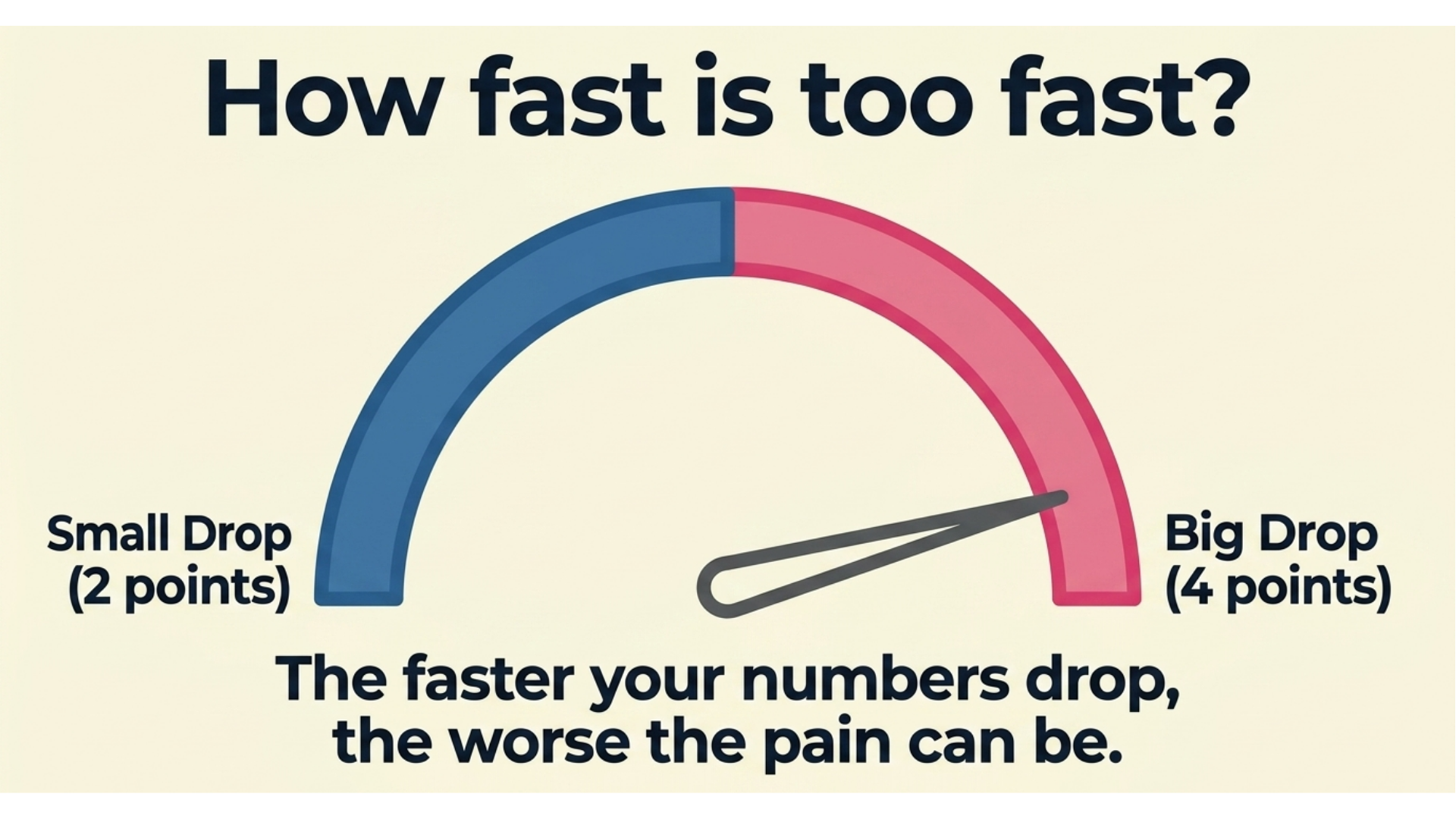
- If your A1C came down two to three points within three months, about one in five people developed this kind of pain.
- If it came down more than four points within three months, more than four out of five people developed this pain.5
So it seems like the bigger the drop, the worse the pain.
And now the study that seems to contradict it
There were researchers in Korea who did something different. Instead of looking at people already going to a specialty clinic, they followed people with ordinary treatment and measured their nerves as the sugars came down.
There was a group that had an A1C of about 11, and it came down to about seven. That’s a huge drop. Again, amazing progress on paper. And according to the last study, that should have affected almost everybody.
However, in this study, their nerve scores did not get worse. Symptoms actually seemed to improve. Maybe 8% of people developed some lightheadedness when they stood up.9
They concluded that fast improvement was not associated with a meaningful short-term worsening. So it sounds like what they’re saying is that even if you drop your A1C fast, most people won’t have any bad side effects. In fact, they’re supporting the safety of intense control with proper screening. Basically, they want you to follow up with your doctor closely and get things under control as quickly as possible.9
Two studies, two answers, and neither one is wrong
Neither one of them is wrong. It’s just that we’re looking at two kinds of populations.
One set of people is already coming in with known issues with their nerves. Another set is simply having diabetes with no known issues with their nerves. So we have one set that is very focused, and another set that is very broad.
The first was looking at people who already ended up at a nerve specialist. The second followed regular people getting regular treatment.
Essentially, the takeaway is that this is not something that happens to everybody who gets their sugar under control quickly. Most people are going to be fine.
The point is to be aware that it does happen to some people. And the useful question is whether or not you might be one of them.
Who might be one of them
You can ask your doctor whether going slower would help you if:8
- You had a very high A1C, at least 10 and above
- That’s been the case for a very long time
- You already have nerve damage
- You already have eye disease or kidney disease
- You get lightheaded when you stand up
Sometimes you may need to go fast. Sometimes you need to get this under control quickly due to other medical conditions that might be at play. But if it is possible for you, would you be able to go slower?
The part that confused me
The man who has studied this the longest also wrote that even though going slow might be recommended, there is no data showing it prevents anything.6
Which is the confusing part to me. How can they tell you that going slow helps you avoid nerve pain, and in the same breath say there’s no proof?
Here is how.
We know that people who drop their A1C fast are usually the ones who end up with this kind of nerve pain. However, it doesn’t seem like we actually know that the blood sugar dropping is what caused it. We don’t know if it’s a cause and effect relationship. We just know there’s an association.
And we also know that people who had high A1Cs for a long time tend to experience this effect.
So what caused it? The really high A1C for a long time, or the sudden drop in blood sugar levels? Was it the speed? Or was the speed acting as a red flag, pointing at who already had a couple of issues underneath the surface?
Because if it’s the second one, then going slower changes the number on the lab report and does nothing for your nerves.
And it doesn’t seem like there have been any studies to settle this. So the recommendation to go slow does exist because the idea seems to make sense — not because anyone proved that it works.
What to do with that
You have that conversation with your doctor, because your doctor is keeping your whole medical picture in mind. Your doctor is looking at your kidneys, your liver, your heart, your brain. If you’ve had a heart attack in the past. If you’ve had a stroke. If you’ve had a stent placement. If your cholesterol is too high. All of these are puzzle pieces that need to be considered to understand the big picture for your health.
So the question is not necessarily whether or not you should go slower. The question is:
How fast are you going? And what is the driver behind that?
The three that will not warn you
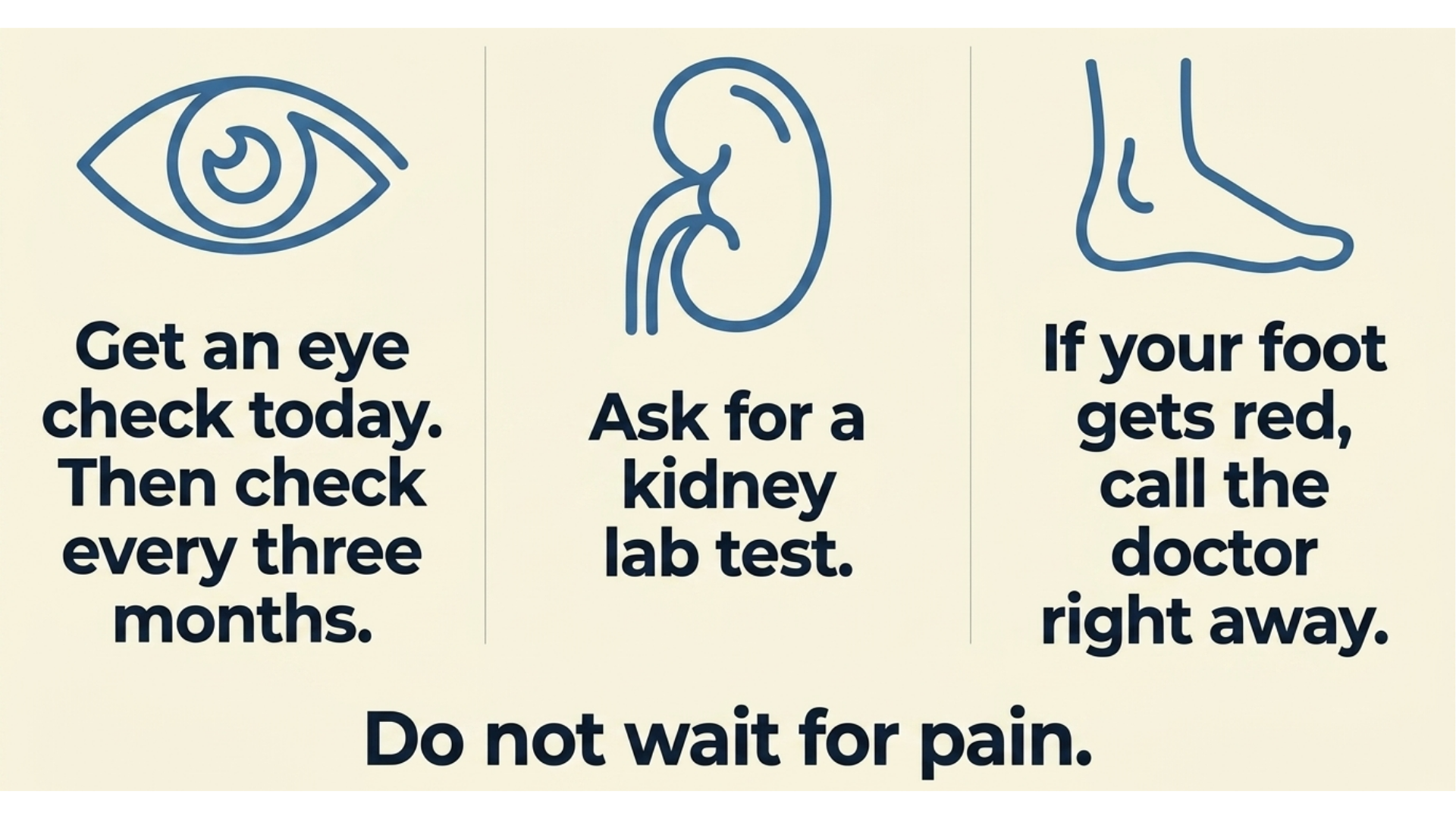
The nerves are not the only thing that can react when sugars come down quickly. There are three other doctors in this story: your eye doctor, your kidney doctor, and your foot doctor.
And not one of them is going to treat something that is causing you pain right now.
Your eyes
These are the typical checkups for anybody with diabetes. However, in the context of TIND, you need to get your eyes checked. Just like the pain can worsen even though your A1C is better, your eyes can worsen too.7
So you definitely need to make sure you follow up with your eye doctor very closely during this transition period.
Your kidneys
Same thing with your kidneys. You probably won’t feel anything in either of these situations — but they are feeling it. And you won’t know unless you check on purpose, because by the time you do know, it might be too late. The damage might be irreversible.5,8
An important difference from the nerves
The weird thing about this is that bringing your A1C down slowly might not actually help you avoid the complications in your eyes7 or your kidneys.
Which may be part of the reason your doctor simply tries to bring everything under control as quickly as possible — because there doesn’t seem to be any added benefit to going slow versus going fast.
The benefit seems to come from bringing your A1C down and maintaining it there, rather than allowing it to have a yo-yo effect. That yo-yo effect will damage your blood vessels further, and therefore affect your eyes, your kidneys, your feet.
Your feet
As for your feet, these are probably your most important assets in following up with your diabetes, because they’re the only thing you can actually see and actually test yourself every single day at home.
You can check every day to see:
- If there are any sores
- If there are any cuts or scrapes or bruises
- If you have pain, or if you don’t have pain — if you’re numb
- Your pulses
A good pulse means good blood flow. And good blood flow means you have the ability to heal from those cuts and scrapes and bruises pretty quickly. And if you heal quickly, you have less chance of infection.
So I’m not telling you that this will happen to you. I’m telling you that people who study this and practice this need to watch out for you, and any change deserves further follow-up. Deserves a phone call. Needs to be seen.
Why these are the ones that get missed
It’s ironic. When your nerves hurt, you feel pain, so you’re driven to get help. But when your eyes are hurting, or your kidneys, or your feet — and they don’t tell you they’re hurting — then nobody picks up the phone.
Nobody says, “I need an eye doctor exam because I have retinopathy and it’s getting worse.” At least not until it’s too late. Nobody calls their kidney doctor and says, “I have to come see you right away because my urine shows high microalbumin levels.”
Often, by the time you find out, the damage might be permanent — and it could have been reversible if you took steps before you found out.
This is usually the most common thing that gets neglected. People do their labs, because it’s convenient. It’s already in the same building as their doctor visit. Sometimes people don’t get their medications, and that might fall through.
But as far as the specialists go, from what I’ve seen, that seems to be where care falls apart. Because people book a specialist when something is pushing them to book that specialist. And usually that something is pain.
But if you have no pain, what is actually driving you to do that? You have to be proactive and book that appointment anyway.
What is still sitting on your list?
Standing still won’t help
Let me ask you something. When the pain started, did you get a little less careful with your sugar levels?
If you did, that’s understandable. The pain began when the numbers came down. So letting them drift back up a little bit seems like a natural thing to do.
But to be honest, it doesn’t work that way. Letting your sugar levels climb again will not undo the pain that you’re already experiencing.
What it does do is leave you with two problems. You have the pain, and now you have uncontrolled diabetes again. And that’s a harder place than where you started, because now you’re not treating the disease anymore. It may be uncontrolled, and you still have the pain that you don’t know how to stop.
So of course you’re probably wondering whether any of this was even worth it. Why did you even start on this road in the first place? It was supposed to help you, and now you seem to be struggling.
It is not a fire. It is a storm.
Earlier I mentioned that it’s kind of like getting out of the frying pan and ending up in the fire. But I want to backtrack a little and say that at least with a fire, you can run out of it. Once you get out, you can stop the pain.
But this is not that. This is more like a storm.
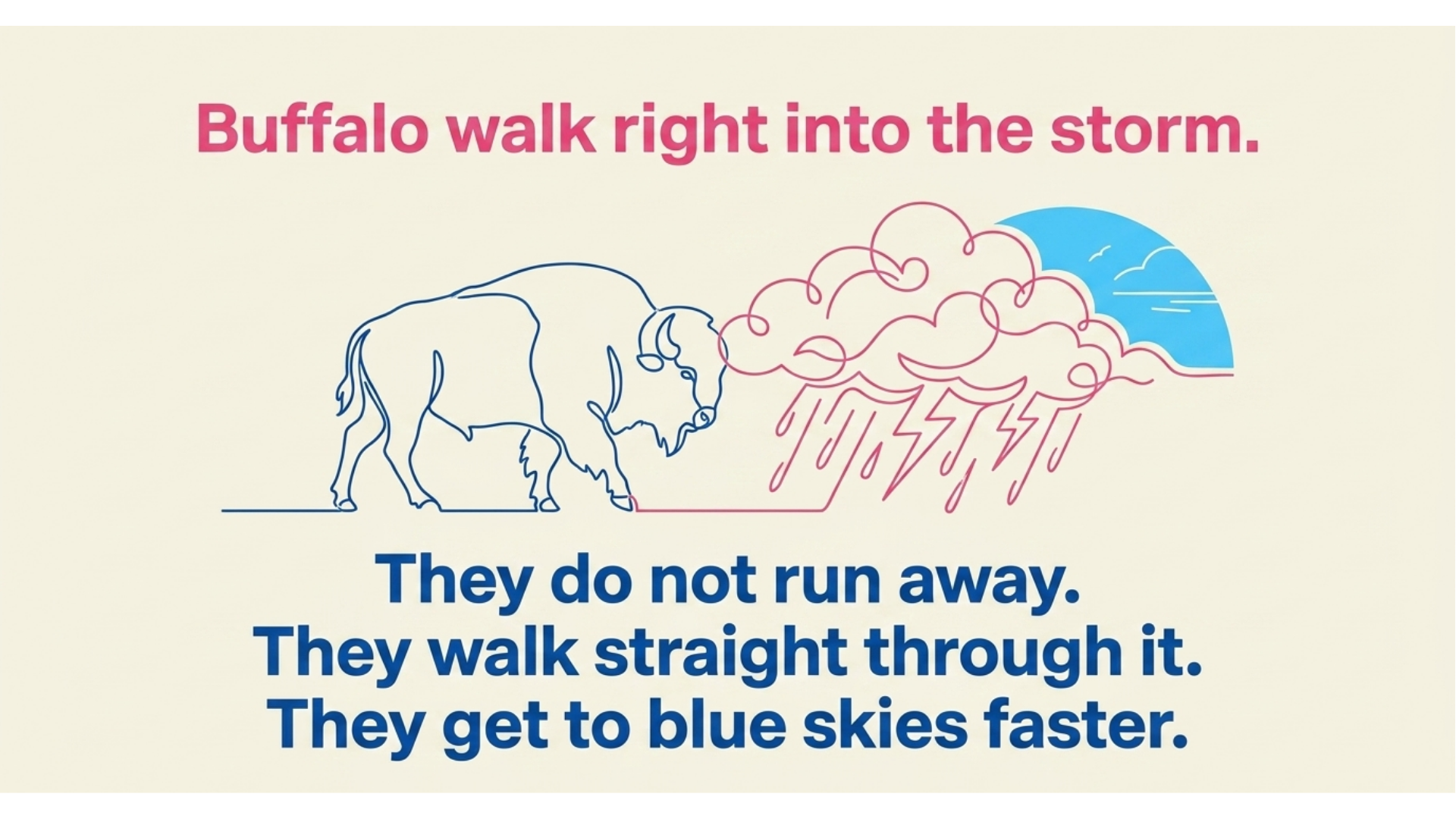
There’s something interesting that I heard about buffalo, and I’m not exactly sure if this is true, so you can check me on that. But my understanding is that buffalo will turn to the storm and walk through it. And because they walk through it, they get through the storm quicker — instead of just sitting in one spot and letting the storm take its time to pass over them.
What walking through it actually means
It basically means holding steady. Keeping control of the sugar levels. Giving your nerves the time they need to settle into the new normal.
If you try to run away from the storm and allow your sugar levels to climb back up, you’re basically allowing the storm to intensify. Because now you have that yo-yo effect. Now you’re causing more damage to your blood vessels, which is causing more issues with the blood supply to your nerves, as well as your eyes, your kidneys, your heart, your brain.
If you control your blood sugars and keep that control, now you’re acting like the buffalo. You have a direction. You know where you’re going. You’re getting through the storm. As long as it takes, you’re going to come out the other side.
And I know that’s hard to do.
However, walking through a storm, you have to be looking at what’s on the other side of it. If all you see is the storm, you’re basically going to walk into it and stay there. Nothing is pulling you forward. So you stand still, or you might walk in circles.
If you have the vision of what’s on the other side, it helps you move forward and understand what you’re walking toward.
So what are you walking toward? I asked you that at the beginning, and now I’m asking again, because it is the thing that gets you to the other side. It is the thing that helps you find the end of the storm faster.
An honest word about how long
For most people, this might settle over months. It might be a year. The storm might grow. It might shrink. It might linger. And there might not be a clean ending. For some people it doesn’t fully resolve. It might thin out. The pain might be more manageable, but never truly go away.1
There are medications that can help you with that. So again, it’s worth a discussion with your doctor to figure out how they can help you get through this — because ideally, the treatment cannot be worse than the disease.
If it is, that’s a conversation that needs to be had. You might talk with your doctor about whether you can ease off the medication for a while, change to something else, or sometimes stop entirely and rethink your strategy. It really depends on your specific situation and what needs to happen for you.
But you may not be offered any of those options if you don’t say anything. So bring up that conversation.
The other storms
Because we’re not just talking about one storm. Realistically, there are several storms happening at the same time.
You might have health issues going on at the same time that you’re struggling to make rent. At the same time that you’re struggling to repair your relationships with your loved ones — your spouse, your parents, your kids. You might be simultaneously struggling to make your boss happy so that the money keeps coming, so you can pay for all the things you need to pay for.
You might be wondering how you’re going to send your kid to college. You might be wondering how you’re going to convince your kid to go to college. You might be struggling to decide: do I put food on the table or go get my medications? Do I need a second job? Do I need a third job? How do I care for my aging parents and my kids at the same time?
The universal truth about being a human being is that it gets messy and complicated.
And what I’m slowly realizing about all of these storms is that they are not failure points. They seem to be transition points. They are the time when you realize that what you were doing, and who you were, is not working anymore. It may have served you well in the past, but now you need something else to carry you through. Now you need to develop a skill. Now you need to develop a character — something that will pull you through and allow you to come out the other side more capable than when you went in.
So what are you carrying?
I ask because your doctor is looking at your A1C. They know what their goal is for you, which is optimal health. Their vision is to get your lab reports in check and keep it that way.
Now it’s up to you to take that vision a step further. What does it mean for you, in the real world, in your day-to-day life, to have a healthy body and an A1C under control?
That seems to be a phase of self-development that can only occur in stormy weather.
If you are already in it
If you already happen to be the person in agony eight weeks after doing everything right — please do not hear this as a warning that reached you too late.
You didn’t do anything wrong. You did all the right things, and it came at a cost that nobody warned you about. Storms happen out of nowhere, and they don’t always sound the alarms on time.
However, what do you do with that? How do you contribute to life? Because everyone has their cross to bear, and that allows you to live a more rich, more meaningful life.
So who actually knows what you’re going through, and what it means for you to push through?
What to bring to your next appointment
Based on everything we’ve talked about, how do you carry this into your next doctor’s appointment? You can take a screenshot of this.
- How fast are we dropping my numbers? What is the goal? That might be different for different people.
- Can we do it in three months? Six months? A year? It really depends on your background.
- What’s making us go that speed? What are the conditions driving it?
- If I get burning pain in my hands or my feet over the next few months, who do I call, and what do we do about it?
- When is my next eye exam? When do I check my kidneys? What do I look for when I check my feet every day?
And you can ask your doctor directly:
Hey, I heard about something called treatment-induced neuropathy of diabetes. Is that something we should be thinking about in my case?
Let the doctor open a discussion with you, because ultimately that discussion needs to revolve around who you are.
The questions you are carrying now
You need to pay attention to what the doctor tells you, because you need to answer some questions for yourself.
- What did you expect to feel?
- What did you actually hear?
- What have you been told?
- How fast are you going?
- How was that decided?
- What is still sitting on your list?
- What else are you carrying?
- Who actually knows what you’re carrying?
- And what are you walking toward?
You don’t need to answer all of these today. The one that made you feel most uncomfortable is probably the one you need to start with.
And when you do that, consider: what’s one small thing you could do differently this week?
We’re not looking for an overhaul. We’re not looking for perfect. We’re looking for a small step.
What are you walking toward?
Your doctor’s goal is your A1C. And that matters. That number is protecting so many things — your eyes, your kidneys, your feet, all of your organs.
But what is your goal? What is the life that lower number is supposed to hand back to you?
Because you can walk through this storm and come out the other side with better control, with your limbs intact, with your eyesight. And then what? What do you do with that gift?
So when you think about what you’re walking toward, the answer is not the A1C. The answer is not simply to get out of pain. The answer is on the other side of the storm you have to go through — the characteristics you need to develop throughout that storm to be ready to receive what comes next. To be ready to receive the blue skies and the rainbows afterwards.
Something is on the other side. Carrying your grandkids around a park with strength to spare. Keeping your own feet. Being able to explore the world. Going hiking. Being able to see the faces of your loved ones. Working a job that you don’t hate, that you actually enjoy and get fulfillment out of.
Whatever it truly is for you, you see it with your mind’s eye. And then you move toward it, because that is the thing that walks you through.
Ultimately it doesn’t matter how long the storm takes to pass. What matters is what you want to be true at the end of it. Who you want to be at the end of it.
Sources
- Pantazopoulos D, Gouveri E, Papazoglou D, Papanas N. Treatment-induced neuropathy of diabetes: a comprehensive literature review. Diabetes Res Clin Pract. 2026;238:113334. View source
- Knopp M, Srikantha M, Rajabally YA. Insulin neuritis and diabetic cachectic neuropathy: a review. Curr Diabetes Rev. 2013;9(3):267-274. View source
- Gibbons CH. Treatment induced neuropathy of diabetes. Auton Neurosci. 2020;226:102668. View source
- Low PA, Singer W. Treatment-induced neuropathy of diabetes: an energy crisis? Brain. 2015;138(Pt 1):2-3. View source
- Gibbons CH, Freeman R. Treatment-induced neuropathy of diabetes: an acute, iatrogenic complication of diabetes. Brain. 2015;138(Pt 1):43-52. View source
- Gibbons CH. Treatment-induced neuropathy of diabetes. Curr Diab Rep. 2017;17(12):127. View source
- Early worsening of diabetic retinopathy in the Diabetes Control and Complications Trial. Arch Ophthalmol. 1998;116(7):874-886. View source
- Dardari D. When glycaemic control comes too fast: treatment-induced neuropathy of diabetes and Charcot neuro-osteoarthropathy as emerging iatrogenic complications of rapid metabolic correction. Diabetes Metab Res Rev. 2026;42(6):e70210. View source
- Choe HJ, Koo BK, Hong YH, et al. The effect of rapid improvement of blood glucose level on diabetic neuropathy in Korean people with diabetes mellitus. Diabetes Res Clin Pract. 2026;238:113388. View source
Health and Wellness coaching
Would it be a bad idea to work together now?
If You’re Not Ready Yet, That’s OK.