Your A1C Might Be Wrong: 5 Reasons It Doesn’t Match Your Meter
When your meter and your lab don’t agree
The A1C came back at 6.2. And even though you test at home, you test while fasting, you test after meals, you have never once seen a number that high. Ever. And the fasting number sits at about 85.
So how could the average be higher than the highest number you have ever seen?
If your lab number and your own meter do not agree, there is a reason for that. And it is not always blood sugar.
Today I am going to show you how the A1C can be pushed away from the truth. You are going to know what the doctors know, and you are going to know what questions to ask to investigate your lab results.
The answer you usually get, and why it is only half of one
I hear some version of this constantly, and somebody posted exactly this issue online, where a few people gave the general answer. Which is to say that when you check your blood sugar with a finger stick, you are only taking a photo. You are only capturing a moment in time. Whereas if you do the A1C, you are seeing the end scene of a three-month movie. You are seeing the average of all of your blood sugar levels across three months.
And so logically they conclude that you might be having spikes of blood sugar without realizing it. Because when you check your glucose with a finger stick meter, you might miss a spike three hours later, even though you already checked two hours after a meal and everything was fine.
That is a perfectly plausible explanation, and it happens very frequently. In order to catch what you are missing, a CGM device would be extremely beneficial, so you can see live glucose readings minute by minute and figure out what is actually causing your blood sugars to spike.
But that is really only half the answer.
When the rubber hits the road, and you are doing everything you are supposed to be doing, and the numbers still just don’t add up — what do you do? That is the whole purpose of this article. How do we investigate this issue?
The A1C is not measuring your blood sugar
The thing I don’t think most people are ever told is that the A1C is not measuring your blood sugar. Not directly. It is measuring your blood cells. More specifically, it is measuring the hemoglobin inside your red blood cells.
Once you see how this test works, you can spot where it goes sideways for you.
You have red blood cells moving around all day carrying oxygen for you, and sugar in your blood sticks to them. A red blood cell lives about three months, and then your body retires it and builds new ones.
So the lab does something pretty clever. They don’t follow you around for three months, minute by minute, second by second. They take a tube of blood and they count how much sugar is stuck to your cells. The more sugar you have stuck, the more sugar that was around.
And it is a pretty good test. I want to be clear that for most people, most of the time, it is a better picture of the last three months than anything you can write down in a log book.
But the test depends on two things:
- Those cells being around for three months.
- Those cells being normal.
If you change either of those, the A1C result is going to change even when your sugar levels are the same.
The laundry hamper
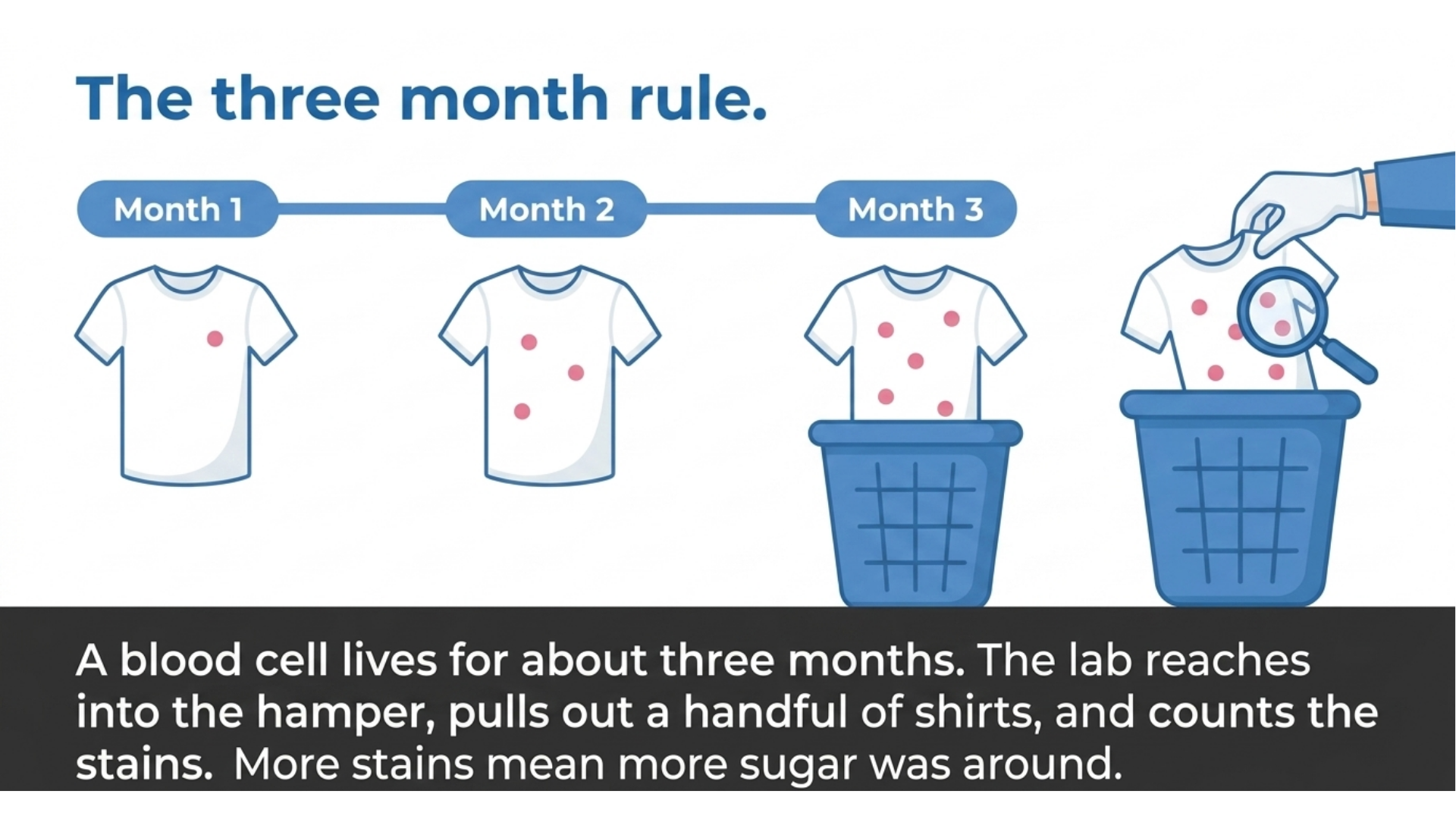
Picture your red blood cells as white T-shirts. Very clean, very pristine, and very easy to stain. Sugar is like spaghetti sauce.
Every shirt you own is currently in circulation. It goes in and out of the closet. And you only ever really buy a new shirt and throw out an old one every three months.
So over those three months, your shirts are going to pick up a little sauce here and there just by normally living your life. Nothing dramatic. Life is messy. You get a drop at dinner, a splash at the counter. Life happens.
The lab never actually sees what you are eating. Nobody is standing in the kitchen with you. Nobody is sitting at the dinner table with you. The lab just reaches into your hamper, pulls out a handful of shirts, and counts how many stains there are. And from the stains, they tell you how you have been eating.
So there is the assumption. They are assuming you have been using your shirts for about three months, and they are assuming that they are shirts.
What if you can’t afford new shirts?
Let’s say the economy is down. We are strapped for cash. We can’t go out and buy new shirts every three months like we used to.
In biological terms, the body is not getting enough iron, so it can’t produce red blood cells as much as it used to.
Researchers in Turkey took a group of people who did not have diabetes but did have iron deficiency anemia. They checked their A1C, and the average was about 7.4, as opposed to a comparison group with an average of 5.9.3
Anybody who walks into a clinic and comes away with an A1C of 7.4 will be diagnosed with diabetes. Anything 6.5 and above is considered diabetes.8
However, the researchers did something a little different this time.
- They did not treat the diabetes.
- They did not tell the participants to change their diet.
- They did not tell the participants to exercise more.
- They did not do anything to modify blood sugar levels.
All they did was treat them with iron. And when they did that, their A1C fell from 7.4 to 6.2. More than a full point.3
A separate group in India found the same thing, where people with worse anemia had higher A1Cs.4
An honest caveat
These were small studies, and the size of this effect is under scrutiny. There was a larger analysis of over 1,300 people, and it showed that A1C actually holds up pretty well even in iron deficiency anemia. Basically they are saying the hemoglobin levels have to go really low for this to have any effect at all.5
So don’t walk away thinking every A1C in the country is off by a point.
What we do need to understand is the effect. Lower iron moves the number up, and treating the iron moves the number down. And every person is different. This might have no effect on you at all, or it might have a significant impact.
Why does this happen? Frankly, it doesn’t seem like anybody really knows. Some people think we are not replacing shirts fast enough, so the hamper fills up with older ones and they have more time to collect sauce stains. Other people think the fabric itself changes, so it is more absorbent and more likely to soak up sauce even though you are eating exactly the same dinner at exactly the same frequency.7
You can take your pick of what you think might be true. They may all be a little bit true. But the argument is not the point. The doctor is interested in helping you.
What if you just bought a closet full of new shirts?
Now flip it.
Biologically, this is what happens if you donated blood last month, or you were bleeding somewhere and didn’t know about it, or somebody finally treated your anemia and your body is churning out new red blood cells as fast as it can.
If you throw out your old T-shirts faster and get new ones, you are going to see fewer sauce stains. Brand new shirts, barely any stains, same dinner. And the lab tells you that you are doing great.7
And that result might actually be worse, because nobody comes back to argue good news. A high number would at least get rechecked. But if you have a low or normal number, you find that reassuring. So you don’t bother going back.
What if they aren’t white T-shirts at all?
A third reason your A1C might be off is that you might not have white T-shirts at all. Some people are walking around with a slightly different kind of hemoglobin, and the machine wasn’t built to read that.
Something like this is inherited. It is genetic. It is common. And most people who have it have no symptoms at all, so they might never be told, because there is no reason to investigate.2
Sickle cell trait is probably the best studied. Roughly one in 13 African Americans carry the trait, and most people who carry it have no symptoms.1,2
Researchers followed more than 4,000 African American adults across two long-running studies. At the exact same blood sugar, the people with sickle cell trait had A1C values about three tenths of a point lower than the people without it.1
That is not a whole lot. But here is the part that should make you think.
When they used the A1C to decide who had prediabetes, they found it in 29% of the people with the trait and 49% of the people without it.1
Same blood sugar levels. Only about half of the people getting diagnosed who should have been.
It does not mean those people were healthier. It means the test could not read that. And since the result never came back positive, they probably didn’t have the conversation with their doctor. They probably didn’t have a plan to figure out what to do next or to get the blood sugar levels down. They might not have monitored it for years — and in the meantime, complications were developing.
The A1C measured your record keeper
Let’s look at this a different way.
The A1C never measured your sugar levels. It measured your record keeper. It only tells you anything about your sugar because your red blood cells were keeping the record. And if that changes, the record changes, even when nothing else in your life has changed.
The man who never had diabetes
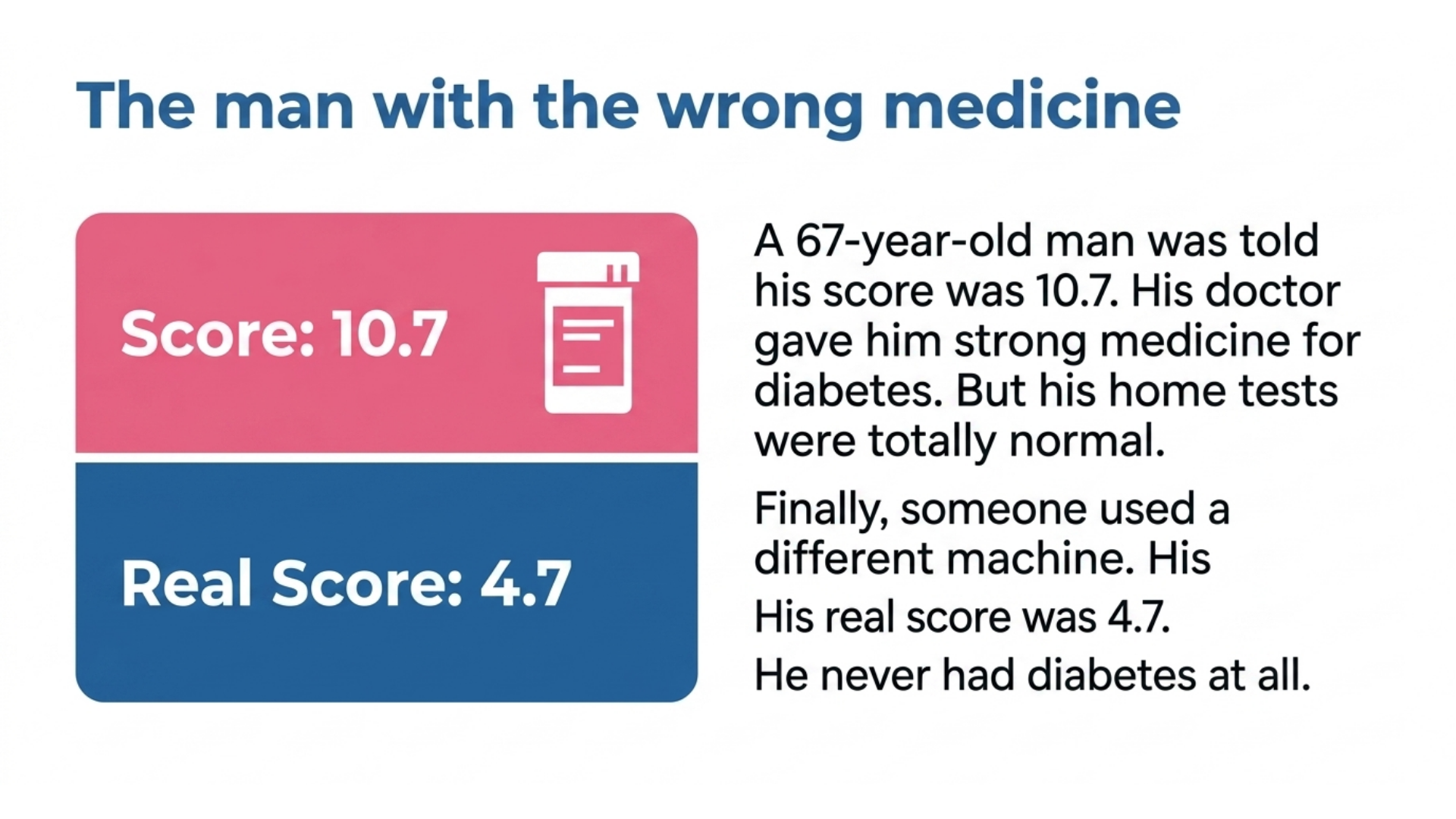
There was a case published in a medical journal about a 67-year-old man. His A1C came back at 10.7.
That is not borderline. That is a number that is definitely diabetes, and not only that, it is uncontrolled. That would make it an average blood sugar of about 260.
They kept repeating the A1C, and every single time it was still over 10. They diagnosed him with diabetes, started him on metformin, and started doing all the usual things to manage high blood sugar.
But the weird thing was that this man was testing at home, and his sugars were running between 92 and 130. Usually that is a really good goal for somebody who has diabetes.
It is really easy to go back and say, “Oh, you are only checking your fasting levels,” or “you are only checking at times when you don’t see the spikes after a meal.”
But somebody finally decided to run a slightly different test. They checked his A1C with a different kind of machine. His actual A1C came back at 4.7.
As it turns out, he had a different kind of hemoglobin that was really rare, and the first machine we normally use in the medical community could not read it correctly.6
He didn’t have diabetes. He never had diabetes.
Now, this is a rare circumstance, and I am not telling you that story because I think everybody should run and get checked out this way. I am telling it because of what had to happen for it to get caught.
Somebody had to notice that two numbers disagreed, and take the patient’s number seriously enough to go looking for a different way to get their answer.
Two conversations that never overlap
None of this is really a secret.
I went and read a thread where family medicine doctors were talking to each other about this exact problem. One of them posted asking what to tell patients whose A1C stays high while their glucose levels seem normal.
There were many replies. They raised iron deficiency. They raised vitamin B12 deficiency causing a falsely high number. They knew kidney disease could have an impact. They knew which alternate tests to order. And one of them wrote that anything affecting red blood cells will make the A1C test unreliable.10
So the professionals know this.
Now step back and look at where patients — people who are not in the profession — ask the same question. Not one of them mentioned any of these issues. Not one mentioned iron. Not one mentioned red blood cells, or what can affect the production or quality of red blood cells.9
There are two conversations happening at the same time about the same test, and they never really overlap.
The one thing that was different: a patient wandered into the thread with the doctors. She said three doctors told her she was fine, an endocrinologist was pushing her to start medication, and nobody ran another test. So she went and read the research herself, and found that she comes from a background where a different kind of hemoglobin is very common, and that hemoglobin can falsely push an A1C up.10
She found that on her own, even though her doctors might have known about it.
The conversation might not have come up for two reasons. For one, as we saw in the iron deficiency study, the normal A1C test is usually a very good test. And for another, doctors are on a time crunch. They hardly have 10 or 15 minutes to speak with you and then they have to move on to the next patient.
So that is the whole thing right there. It is not a knowledge problem, because the knowledge exists. It is a delivery problem.
Your doctor is playing the odds game. It is not incompetence. It is how the health care system functions, and what the probabilities are.
But regardless of anyone’s intentions, you are the one who has to live inside that number. So you need to know what to ask.
Before you go and ask, please read this
One more thing before you go and ask. I want to say this very clearly, because I know this article could land wrong.
If you have been diagnosed with diabetes or even prediabetes, this is not permission to decide that your diagnosis was some sort of testing error and walk away from it and stop taking medication. That is not what I am saying.
The A1C is usually right. Most high A1C results are high because blood sugar was high. That is the ordinary explanation, and it is ordinary because it is true.
What I am describing is the exception. And you look for the exception when the numbers genuinely don’t seem to fit each other — not when you don’t like the numbers.
So don’t change anything because you don’t like to see high numbers. Talk to your doctor about how to get them under control. And also talk to your doctor if you are noticing that your numbers at home and your numbers from the lab don’t seem to fit.
If it turns out that yours is real, that is just the information you need to figure out what your next step is.
How to bring this to your doctor
How do you have that conversation? What do you actually say in the room?
Don’t walk in and say you think the test was wrong and you want a retest or a different test. That doesn’t really help anything.
What you can say instead is:
I noticed my home readings are a little lower than my A1C, and it doesn’t seem like they match up. Can we figure out which one to trust, or can we do a different test that might clarify some things? Where do we go from here?
That’s pretty much it. That is a question your doctor can work with, and most of them will take that concern seriously.
They might ask what your blood glucose levels are at home, and whether you are keeping a log. They might ask about your background. They might ask if you have any history of sickle cell trait or sickle cell disease in your family. They might look at your lab results and see if there is any anemia to explore.
Five questions you can ask
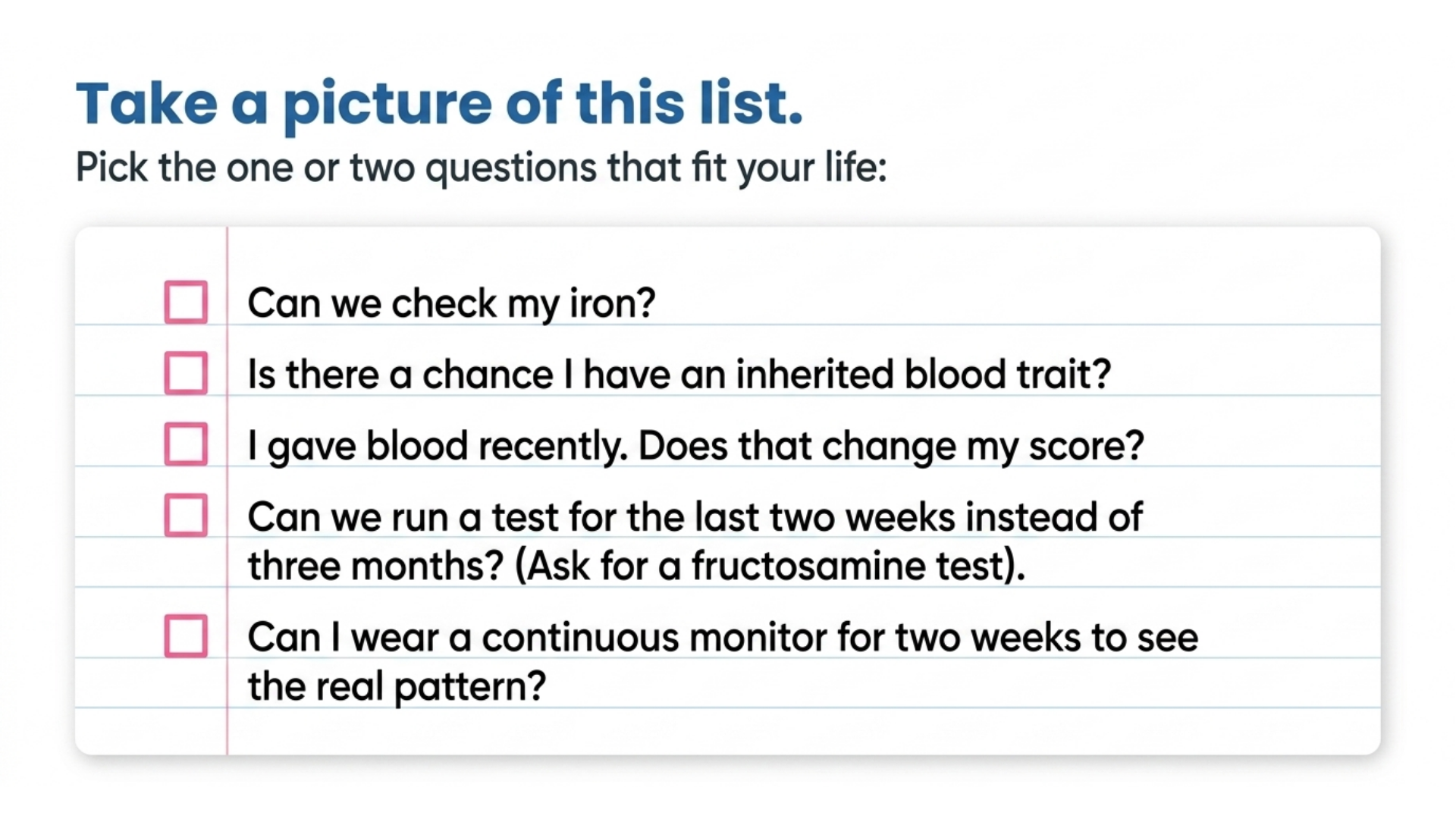
You are not going to need all five. Pick one or two that might fit you.
- Can we check my iron and CBC levels? Iron deficiency can push up the A1C.
- Is there any chance I have a hemoglobin variant? Especially if you have African, Mediterranean, Middle Eastern, or Southeast Asian ancestry anywhere in your family. You can have sickle cell trait or sickle cell disease. You can have thalassemia. There are all kinds of ways the hemoglobin itself might change the result.
- I donated blood recently, or I have been bleeding, or I was treated for anemia in the last three months. How does that change my score?
- Can we run a different test — a fructosamine test or a glycated albumin test? Those measure roughly the last two or three weeks, and they don’t depend on your red blood cells in the same way. When the normal A1C is unreliable, this can break the tie.
- Can I wear a continuous glucose monitor for two weeks so we can see the actual pattern? It may be that the normal A1C is correct, and we need to identify why it is correct.
So which number is wrong?
Frankly, I don’t think that is the question we need to answer.
We need to answer: what is your goal?
The doctor already knows their goal for you, which is to see normal lab reports. And they want that because it reduces the risk of complications down the road. That is a great goal, because ultimately we are looking for you to live a normal, healthy life and enjoy your time on this earth.
So that leads us to your goal. What is that number actually for? Why do we care to understand the nuances here?
If that A1C is a little off in the reassuring direction, you lose years you could have spent controlling the issue and keeping complications at bay.
If it is off in the other direction, you are taking medications you may never have needed and carrying a diagnosis that was never really yours. The impact of that could be physical as well as mental.
Either way, somebody has to notice that the shirts in the hamper don’t match the dinners you have been eating. And it turns out that somebody is often you.
Why is that? Because you want to live your life to the fullest. You want to live your life in alignment with your values. You want to live your life with strength, with confidence, with the assurance that your body will carry you through this world so that you can do what you need to do for who you care about.
So the next time you get a lab result back and something about it just doesn’t sit right — don’t talk yourself out of it. Bring it in. Talk to your doctor. Highlight that the numbers don’t match up, and have that conversation.
And to support that conversation, ask yourself: what is one small thing you can do this week?
Maybe it is just writing down your blood glucose readings in a log and comparing them to your last A1C. Do they tell the same story? If not, that raises a flag — something you can consider looking into. And that may be the feedback you need to course correct, so you can live a life with more quality and meaning.
Sources
- Lacy ME, Wellenius GA, Sumner AE, et al. Association of sickle cell trait with hemoglobin A1c in African Americans. JAMA. 2017;317(5):507-515. View source
- National Institute of Diabetes and Digestive and Kidney Diseases. Sickle cell trait & other hemoglobinopathies & diabetes. NIDDK. View source
- Coban E, Ozdogan M, Timuragaoglu A. Effect of iron deficiency anemia on the levels of hemoglobin A1c in nondiabetic patients. Acta Haematol. 2004;112(3):126-128. View source
- Rajagopal L, Ganapathy S, Arunachalam S, Raja V, Ramraj B. Does iron deficiency anaemia and its severity influence HbA1C level in non diabetics? J Clin Diagn Res. 2017;11(2):EC13-EC15. View source
- Bhargava S, Mahato K, Manocha A, et al. Interpreting HbA1c in presence of deficiency anemias. Indian J Clin Biochem. 2020;36(3):360-364. View source
- Chen J, Diesburg-Stanwood A, Bodor G, Rasouli N. Led astray by hemoglobin A1c: a case of misdiagnosis of diabetes by falsely elevated hemoglobin A1c. J Investig Med High Impact Case Rep. 2016;4(1):2324709616628549. View source
- National Glycohemoglobin Standardization Program. Factors that interfere with HbA1c test results. NGSP. View source
- National Institute of Diabetes and Digestive and Kidney Diseases. The A1C test & diabetes. NIDDK. View source
- Community discussion, r/diabetes: “a1c does not match at home testing.” Accessed August 12, 2026. View source
- Community discussion, r/FamilyMedicine: “When A1c and blood glucose don’t match.” Accessed August 12, 2026. View source
Health and Wellness coaching
Would it be a bad idea to work together now?
If You’re Not Ready Yet, That’s OK.