Retatrutide: How to Think About It Before It’s Available
So, there is a new weight loss medication that’s being studied right now and it’s getting a lot of attention because it seems to be faster and better than Ozempic or Mounjaro.
We’re going to talk about what this medication is, why it’s different, and how to talk to your doctor to figure out if this is the right path for you.
And I think that if we start there, everything else will make a lot more sense.
What Is Retatrutide and Where Does It Stand Right Now?
So, just to give a little bit of context, Retatrutride is currently in phase three clinical trials as I make this video.
And from what I’ve been reading, it looks like Eli Lilly, which is the company that’s making this medication, is aiming for FDA approval sometime later in the year of 2026, maybe early 2027.
So, we’re probably looking at roughly about a year before this medication is available for prescription.
So, we have some time to do a little bit of leg work and figure out if this is going to be a good fit for us with our doctors.
Why Retatrutide Is Different – The Triple Agonist Explained
And it can be a good fit because it seems like it’s the next step in the evolutionary scale of these kinds of medications.
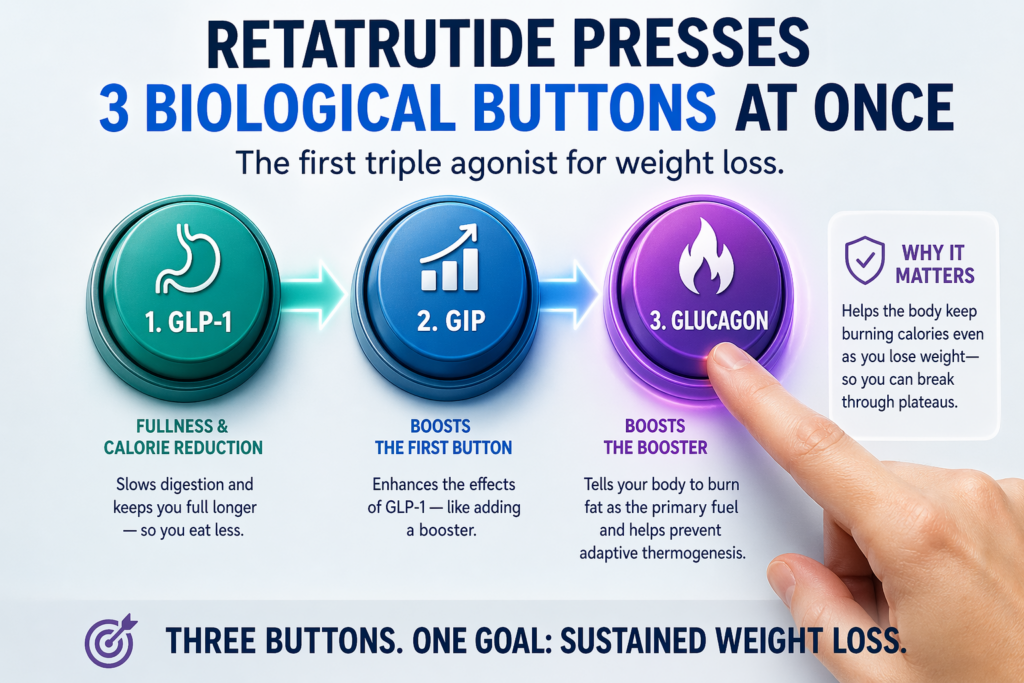
You have Ozempic, which is a GLP-1 agonist, which basically means they’re using one finger to press one biological button.
The newest medications that are currently available for prescription are dual agonists.
So, they use one finger to press two buttons at the same time.
With Retatrutide, it looks like they’re promising that they can use one finger to press three buttons at the same time, which is something we haven’t seen before.
So, what are these three buttons?
Button 1 – GLP-1: Fullness and Calorie Reduction
The first one is GLP1, which makes sense because that’s what these medications were named after.
Basically, it slows down your stomach and keeps you full longer.
Not only that, but it actually makes you feel full longer.
So you don’t actually feel like eating.
If you don’t feel like eating, you’re not going to eat. And that will reduce the number of calories that you take in.
So this mechanism basically plays on the idea of calories in versus calories out in order to help you with the weight loss.
Button 2: – GIP: Boosting the First Button
Then came the dual agonists, the one finger that presses two buttons.
And this time we’re pressing GLP1 and GIP.
And by doing this, you enhance all of the effects of the first button.
So by pressing the second button, you enhance all of the effects of the first button. It’s kind of like adding a booster to your car to make it go faster.
So that way you actually burn more fuel in faster amount of time.
Button 3 – Glucagon: Boosting the Booster
And now the third button enhances the effect of the second button which enhances the effect of the first button.
So it looks like you’re boosting the booster.
This seems to be the thing that makes retatrutide stand apart from everything else right now because it looks like it’s able to tell your muscles and your liver to burn fat as the primary source of fuel.
Why This Matters: Adaptive Thermogenesis
And this is important because there’s something called adaptive thermogenesis.
Basically, when you eat less food, you’re going to take in fewer calories.
When you eat less calories, your body is eventually going to burn less calories.
And that’s when most of us hit a wall or that plateau and we give up our weight loss efforts because it looks like we’ve stopped progressing.
So, it looks like people are very interested in this medication because it seems to prevent that from happening.
The Social Media Red Flag – What You Need to Know
And because it’s so desirable, I’m already finding pictures of people having before and after images from taking this medication.
So, I want to take a step back and be as straightforward as possible about this because the fact of the matter is that this medication is not yet available via prescription.
And it’s not available because it’s still being tested.
It’s still being tested because they’re still trying to figure out what are all the benefits and what are all the dangers.
Also, the people that are participating in these trials probably sign some sort of agreement that prevents them from sharing their results.
So, if you do find people that are sharing their results with this medication, they may be getting it from somewhere else other than a prescription.
The Real Danger of Getting It Outside a Prescription
So, the real concern is that if you can’t get it through a legitimate prescription, then there may be no quality control.
So, how do you know what you’re actually getting?
You might think that you’re buying retatrutide, but what’s actually in that vial may be a different story.
And it’s potentially a risky story because you may end up hurting your organs or causing some sort of internal damage, particularly if your doctor doesn’t know about it and therefore is not running regular tests to make sure that everything is okay with your organs.
So, in a way, this is kind of a public health message that if you come across any of that content, be extremely skeptical about what you see and scrutinize every word and every image because right now it’s simply should not be in anyone’s hands.
The company making this product is still running tests.
With that said, we can still do our leg work ahead of time to prepare ourselves when this medication comes out and becomes available.
What Does This Mean for You Personally?
So, now let’s talk about what this medication may mean for you personally.
And I think it helps to break this down into two types of people because the conversation with your doctor looks pretty similar, but it can be different depending on where you’re starting from.
Type 1 – You’re Already Taking a GLP-1 Medication
So the first type of person is someone who’s already taking a GLP-1 medication.
Maybe you’re on Ozempic or you’re on Mounjaro or Zepbound or Wegovy.
And the question for you is: Would there actually be a benefit to switch to Retatrutide when it comes out?
Honestly, we don’t fully know yet because the company is still in its final testing phase.
Until we know the complete profile of this medication, we don’t know how it’s going to fit into your medical background.
So, that’s definitely a conversation worth having with your doctor once these tests are completed.
Type 2 – You’re Not on Anything Yet
The second type of person is someone who is not taking anything yet.
Maybe your doctor mentioned that a GLP-1 medication could be helpful for you, but you might not have started anything yet.
In that case, it seems like the main question would be: Should you wait for retatrutide or do you go ahead and start something that’s already available?
This is where things get a little bit more nuanced because they don’t just help with weight loss.
They actually have an impact on your cardiovascular system, which is important when you’re thinking about whether or not to wait for a year.
Your doctor needs to go through your own risk profile based on your medical background in order to figure out how urgent is it to start a medication now versus later.
And there are tools to help your doctor figure out what your risk of heart attack or stroke might be over the next 10 years.
This helps your doctor get a clearer picture of how important it may be to start medication right now versus waiting.
So regardless of which group you fall into, whether you’re already taking a GLP1 or you’re considering it, the fact is that retatrutide is still being tested (at the time of this writing).
How to Talk to Your Doctor About Retatrutide
So, how do you actually have this conversation with your doctor and what questions should you be asking?
Because the thing is that nobody’s going to know whether this medication is right for you better than your doctor.
So, you do need to be able to speak to your doctor on a medical level.
And it’s not really that hard.
Start With These Questions
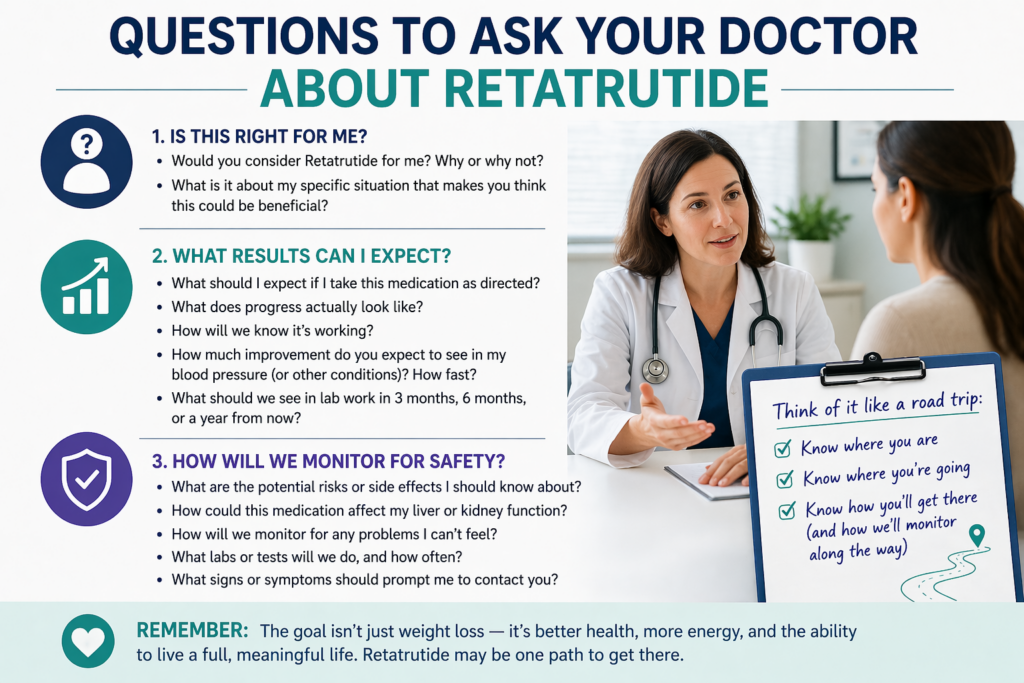
The first thing I would encourage you to ask is: Would you even consider this medication for me? And why or why not.
Another question would be, what is it about my specific situation that makes you think this could be beneficial?
That question basically opens up a conversation that a whole lot of people never really have with their doctor because they either wait for their doctor to bring it up or they don’t know how to start.
So, you want to think of this like a road trip.
Essentially, you need three elements:
- You need to know where you are,
- Where you’re going, and
- How you’re going to get there.
So, when you ask something like, “Would this medication be good for me, and why?”
You’re trying to figure out where you’re even starting from.
And since you already know where you want to go, your next questions are going to be related to how you’re going to get there.
Setting Milestones Along the Way
So, you may ask,
- What should I expect if I take this medication as directed?
- What does progress actually look like?
- How do I know it’s working?
Because “working” doesn’t just mean weight loss.
These medications can have a big impact on your:
- Blood pressure,
- On your diabetes,
- On your cholesterol levels.
- So many other things can benefit.
So you want to know what the milestones are along the way.
- How much improvement do you expect to see in your blood pressure? How fast?
- What should we be seeing in the lab work in three months or 6 months or a year from now?
Monitoring for Harm – Not Just Progress
Probably equally, if not more important than the beneficial impact is the detrimental impact.
We want to make sure we’re getting to our destination safely.
So, how do we know if something’s going wrong?
You might feel completely fine even though something is going terribly wrong inside of your body.
These medications are known to affect your liver function and your kidney function.
And the only way to catch that early is through regular labs.
So you need to ask your doctor, how are we going to monitor this over time?
Not just for the benefits, but for any potential damage that might be happening that we can’t feel.
Think of It Like Monitoring Your Car on a Road Trip
The same thing with your car.
While you take that road trip, you’re constantly monitoring the gauges in your car. So, you’re looking out for the temperature of the engine.
You’re looking out for how much gas is left in the tank before you need to stop for a fill up.
You’re looking out for that check engine light.
So basically, you’re not only figuring out what road to take to get to your final destination, you’re figuring out what are the milestones along the way and also you’re constantly monitoring the well-being of your vehicle.
And all of these things together are what’s going to get you there safely.
The Real Why – Reframing the Goal
And the real question is, why do we even want to get there?
I feel this is probably the most important thing that we’re going to talk about today because before you walk into your doctor’s office and start researching medications and reading about side effects and looking up clinical trials and all of that, I feel you need to sit with just one question.
What are you trying to get back?
Weight Loss Is Not the Destination
We’re not put on this planet to be weight loss machines.
That is not our purpose.
Any medication, no matter what it is for, should serve something bigger than a number on your bathroom scale.
It should serve your ability to be present, to do good, to bring richness into your life and through your life into the lives of others.
Finding Your Real Destination
So, what is it that’s motivating you to explore this medication?
If it’s simply to help you get your health back, that’s definitely worth more than a million bucks.
Is it that you want to remember what it felt like to be a kid again with all that energy, that joy, that just sheer glee and curiosity and sense of adventure to explore the world, whatever it is for you, just hold on to that because that is your real destination.
Retatrutide or any medication is really just one possible path to help you live that full and rich life.
So you really just need to know where you are, where you want to be, and how to get there safely.
Your doctor can help you figure that out, but only you can decide why you want to go there.
When you’re clear on your why, every conversation you have with your doctor becomes a lot more meaningful and a lot more useful.
So, thank you for reading and we’ll see you next time.
Health and Wellness coaching
Would it be a bad idea to work together now?
If You’re Not Ready Yet, That’s OK.