Which GLP-1 Is Best for You? Ozempic, Wegovy, Mounjaro, or Zepbound?
All right, let’s say you meet up with a friend and they look phenomenal. They lost a whole bunch of weight. They look vital. They have so much energy.
And you can’t help but ask them, “What did you do?” And they tell you, “Oh, my doctor prescribed me,” and they name the GLP-1 they’re using. “My doctor prescribed me Ozempic,” or “my doctor prescribed me Mounjaro,” or “Wegovy,” or “Zepbound.” And now there’s retatrutide coming down the pipeline.
So you run over to your doctor and you say, “Hey, my friend had this, they got great results, I want the same thing.”
The thing is, your friend got a medication that works for THEM. It might not necessarily work for YOU.
So we have to ask ourselves:
- What medicine is actually right for you?
- Why are you looking for the same drug that your friend got great results with?
- And how do you know which medication actually fits your life?
By the end of this article, we’re going to
- Walk through the different options inside your doctor’s head, so you get a sneak peek into how they might be thinking about the medication.
- You’ll get a better sense of what medication may actually fit your life,
- And you’ll have a set of questions for your next appointment so that you can walk in and make the most out of those fifteen minutes that you get.
So let’s get started.
What Are GLP-1 Medications Actually For?
We really need to understand what our real goal is.
These are not necessarily weight loss drugs.
GLP-1s were built to help people regain control of a dangerous chronic condition.
The Biggest Misconception About Ozempic, Wegovy, and Weight Loss
There is a common misconception straight out the gate.
Whenever a patient comes into the office, they really want to talk about getting one of these medications because their friend looks great.
So when the doctor starts talking about diabetes, they’re kind of surprised, and they usually say, “Oh, I don’t have diabetes.” Or, “Do I need to test for diabetes?”
So we need to get clear on the goal, because these medications are not created equal.
Some are designed to help treat diabetes, and some are designed for weight management.
And this is a really important distinction to get straight from the beginning, because it’s not just you and the doctor in the room.
Your insurance company is there too.
And they want to know why something is being prescribed so that they can decide whether they’ll pay for it, or if you have to pay out of pocket.
So work with your doctor and ask:
- are we treating my blood sugar?
- Are we treating my weight?
- Are we treating any heart health issues?
- Are we trying to go for all three?
- What is your unique situation?
Because making this distinction is the first real fork in the road, since the medication that you need is optimized for your goal.
For example, I’ll tell you a story.
I was looking for a new phone recently.
And as I’m sure you know, there are so many options out there, it’s overwhelming.
And every phone has so many bells and whistles that it’s also overwhelming.
So how do you know what to get?
Well, for one thing, you need to know what you’re going to use the phone for.
You need to know the PURPOSE.
What’s important to you?
- Is it important that it has a really good camera?
- Is it important that you just use it to talk with your friends or text your friends?
- Is it important to have a ton of memory because you store a lot of music on your phone?
You need to know what your goal is.
And in this case, you need to know what your medical goal is.
Ozempic vs. Wegovy vs. Mounjaro vs. Zepbound: What’s the Difference?
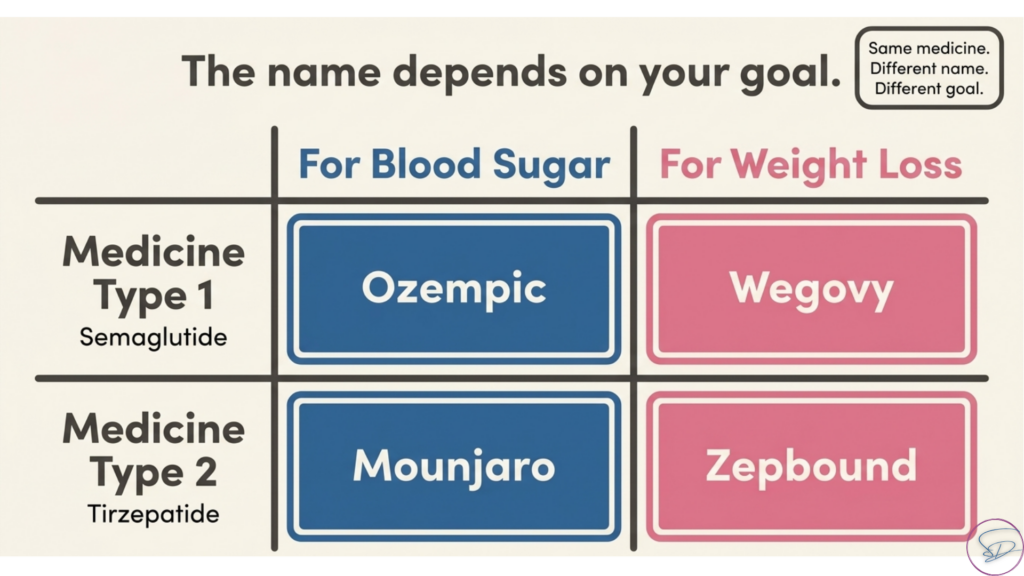
Are you trying to treat type 2 diabetes?
If that’s the case, maybe something like Ozempic or Mounjaro are the better options for you.
If you need assistance with weight management, then maybe Wegovy and Zepbound are the better options for you.
Same Medication, Different Name, Different Goal
This is not to say that Ozempic, for example, cannot help you with weight loss.
It actually can, and it can also help you with heart health.
And it’s not to say that Zepbound cannot help you with type 2 diabetes.
It could.
There is some crossover between what these medications can do.
And even though these drugs are nicely situated into categories, your doctor may decide one or the other because they appreciate the overlap.
But they also know what they’re looking for to have the most optimal treatment for you.
It’s all about picking the best tool in your tool belt.
Semaglutide vs. Tirzepatide: Which One Is Right for You?
Once you know why you’re being treated, the next question is which molecule?
- Are you going to use a hammer?
- Are you going to use a wrench?
- Are you going to use a combination of the two?
That’s why we need to work with our doctor.
Because they have the technical skill and know-how about how these medications actually work, and which one might be the best option for you at a given time.
So you can ask them:
- Which tool fixes my problems best?
And once you agree on a shared decision, then you can start to ask questions like:
- If the goal is weight loss and you’re prescribing me this medication, how much improvement do you expect to see, and how fast?
Same thing with a goal for diabetes:
- How much improvement do you expect to see in my A1C, three months down the road or six months down the road?
So you can start thinking forward a little bit, to make sure that you’re on the right path and making the right decisions for you.
Now, you might have picked the perfect medication with your doctor, and it looks great on paper because that’s exactly what you need for your unique medical issues, if you have any.
However, it doesn’t mean much if your tummy feels crummy.
What Side Effects Should You Expect From a GLP-1?
Probably the number one complaint that I’ve heard is that people feel nauseous, and they feel like they’re always going to throw up.
And that’s just the nature of the medication.
It makes you feel full and probably uncomfortable.
As if you just had a big buffet and you overstuffed yourself because you haven’t eaten in a long time.
The trouble some people have is that they always feel this way on the medication, and they either
- Put up with it,
- or they can’t.
And probably the real issue is that they’re surprised to experience it.
Questions to Ask Your Doctor Before You Start
So ask these questions to your doctor:
- When should I call you if I feel sick?
- What side effects should I expect in the first few weeks?
- And what symptoms mean that I should stop the medicine and call you or get urgent care?
Because some of the things your doctor is looking out for is:
- Whether or not you get dehydrated,
- Whether or not your pancreas gets inflamed,
- Or if you have any gallbladder problems.
- They’re also monitoring your kidney function and your liver function.
So you need to be following up closely with your provider.
And really, it comes down to: can you actually keep taking it?
There are a couple different factors about that.
For one, if you get past the side effects, or you experience no side effects, that’s wonderful for you.
Can You Actually Afford to Keep Taking It?
But now the thing that kind of overrides every other decision point is whether or not your insurance will pay for it over the long term.
Because these are long-term therapies.
Usually, when someone starts the medication, they’re basically taking it for life, at least from a medical standpoint.
If they stop taking it, usually the weight comes back, or the diabetes gets worse.
And insurance companies have very strict rules about what they will and will not cover, and why they’ll cover something.
So if you don’t match up with all of their prerequisites, they might just one day stop covering the medication, or they might not cover it to begin with.
So you need to ask your doctor:
What happens if I have to stop the medication for whatever reason?
- Either you can’t tolerate it because you have so much nausea,
- or maybe the insurance just won’t cover it anymore,
- or maybe there’s a shortage of the medication and you just can’t find it anywhere because it’s not stocked in any of the pharmacies.
So you need to get an understanding of what the alternatives are, what you can do differently.
Basically, how can you pivot in a moment of difficulty?
Training Wheels or a Crutch? The Question Nobody Asks
Now, that is assuming that you are strictly relying on the medication to carry you forward, and I need to caution you against that.
There are people whose lives depend on taking the medication for the rest of their life.
However, I’m a strong believer in using medication as a transition point.
In my view, the ideal is that people use medication to help with a problem that they are currently having, so that you have the time to make the right changes so that you no longer need to use that medication anymore.
That’s not always going to be the case for everybody.
There are always people who are doing the right things, but they still need the medication.
But as long as you’re on a path of betterment and growth, that’s okay.
Medicine is just one part of your story. It’s a question of how you will use it.
So I’ll give you a quick story about my dad.
My Dad’s Story
He’s the kind of person who needs detailed information before he’s convinced of anything.
And I can’t blame him.
I’m the same way. That’s why I went to med school.
It took a long time to convince him to start Ozempic.
And to this day, I’m not entirely sure why he finally decided to start.
And since starting the medication, he’s made some real changes to his diet and his exercise.
So on the outside, that’s exactly what you would hope for.
The medication is basically being used as training wheels toward a healthier life.
But if I’m honest, there is another layer.
An Honest Layer
My dad has a demanding job and a demanding household.
There’s a lot of stress on him.
Life isn’t easy for him right now.
And some days, I think the medication is what lets him keep eating the comfort food he needs to cope.
And I just want to put this message out there:
If that’s what you need to do to get through a season of your life,
- to get through some kind of struggle,
- to deal with a new project at work that nobody seems to know what they’re doing,
- or you need to work the graveyard shift for the coming months just to pay the bills,
- or if you’re going through a breakup,
- or frankly, if you’ve just had enough of life in general and you need time to recover,
then please take that time.
Just make sure that you’re following up with your doctor regularly during that time.
You might need that medication to carry you through.
I just don’t want you to get to a point where you have to go back for more medication.
You can choose to do that on purpose if it’s required.
It’s just interesting that you can see both needs being met.
You can see both paths crossing throughout your life.
And neither path is right or wrong necessarily.
I’m just letting you know that it can get pretty complicated, because it comes down to what you want your life to look like.
Two Patients, Two Very Different Paths
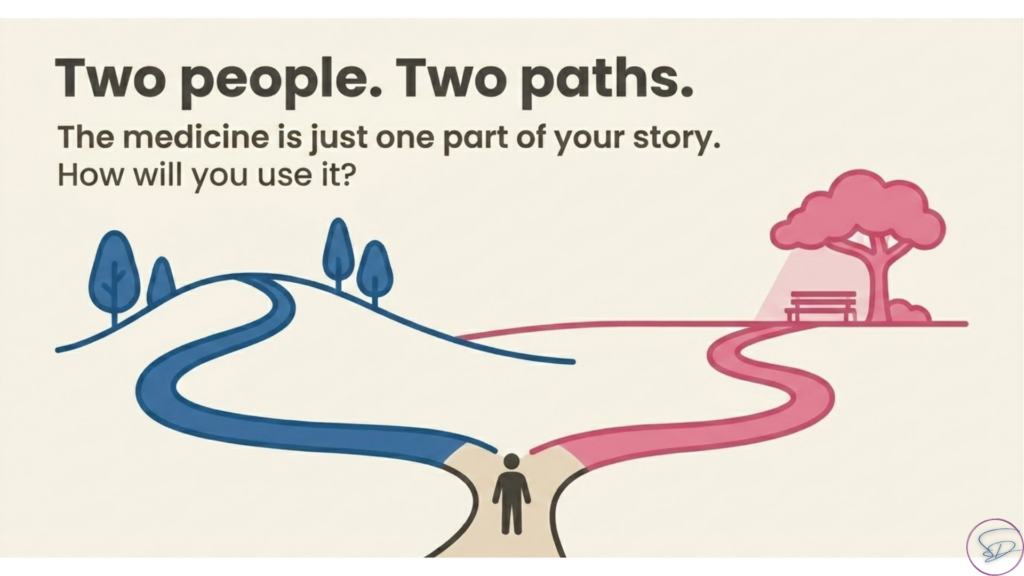
There are a couple of stories that I want to share.
Patient #1
One patient started Ozempic, had drastic weight loss and much better control of their diabetes.
Then they had to switch their medication.
So when they switched, they regained some weight, and they got frustrated and they stopped everything.
So what actually turned things around wasn’t a different medication.
It was changing her diet and walking regularly.
Walking every day after work.
And once she did that, her weight, her diabetes, her energy, all of it improved all at once, together.
And she was able to sustain it without any medication carrying the whole load.
So she now knows that she can do these things, make changes herself, and if she chooses to use medication, it will be to augment her results, not to get them.
Patient #2
Here’s a story of another patient with kind of a different twist, because that patient also started on Ozempic for their diabetes.
And the thing is that they were really focused on weight loss.
So they overhauled their life.
They hit their diet hard, they hit the gym hard, they did everything, and they got real results.
And with every visit, they wanted to get a higher dose.
They really wanted to max it out.
And they only recently got comfortable trying to start scaling back down.
In the meantime, they noticed themselves slipping back towards old habits just to protect the number on the scale.
And they wanted to go back up on the dose rather than sit with that discomfort.
It was a difficult conversation to have because they weren’t open to trying anything else.
Even though their diabetes was now well controlled and the insurance company might stop coverage for the medication altogether, because they know that medication works and they’re fearful of going back to the way things were.
Suggesting alternative therapies, or even the prospect of needing to go on a different medication because of insurance coverage, was a difficult conversation to have for this person.
So hopefully we planted the seed for them to start thinking about a transition period.
While they had their priorities straight, the rigidity of how to get there and achieve those values concerned me.
So, is a medication really helping if you can’t imagine functioning without it?
Maybe.
Some people genuinely do need that specific medication for their life, and that’s a legitimate outcome, not a failure.
But I don’t want you to become complacent.
If anyone finds themselves in that position, keep asking:
- Has enough changed in how I live that we should revisit this?
- Do I really still need this medication?
- If I do, how much?
- Is this medication really helping me get to a better point in my life, get to a more fulfilling life?
- Helping me raise my kids better, helping me be a better spouse, helping me be a better son, helping me be a better member of my community, helping me give back to my community?
You need to get clear on your purpose.
How to Get Clear on Your Goal Before Your Next Appointment
If there’s one thing I want stuck in your head after this, it’s this:
Don’t go after these medications like your life depends on them.
For some people, their life does depend on these medications, and that’s fine.
I just want your mind to realize that medications are not here to improve your life or enhance it.
They’re here to assist you in achieving your goals.
The One Question Worth Asking Before You Start
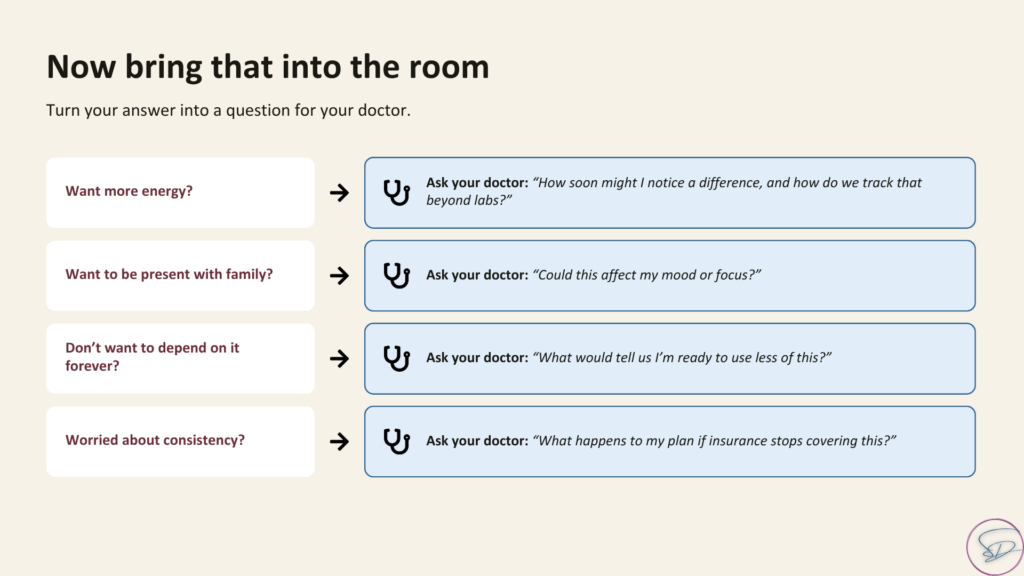
So before your next appointment, you need to sit down with a few questions.
What would this medication actually do for your life?
And I don’t mean how will it lower your A1C, and I don’t mean how will it get the bathroom scale under control. Those things will come as a result.
What I do want to know is:
- How would this medication give you more energy to play with your kids?
- How would it help you be more present with your spouse?
- How would it help you feel focused and satisfied in your work again?
- How would it help you trust your own body again?
I’m not saying that a GLP-1 is the only path.
There are so many other approaches, and your doctor will know and talk with you about what’s realistic based on your medical background.
With that said, you need to get clear on the vision first, and the right option gets a lot easier to recognize.
Because once you answer these questions, you can translate them into your next appointment.
- If you want more energy:
- how soon might I notice a difference, and how do we track that beyond the labs?
- If you want to be more present with your family:
- could this affect my mood or focus?
- If you don’t want to depend on the medication forever, you ask the doctor:
- what would tell us if I’m ready to use less of this, or eventually stop using the medication?
- If you’re worried about not being able to take the medication consistently, you can ask the doctor:
- what happens to my treatment plan if my insurance stops covering this?
How You’ll Know It’s Actually Working
Because six months from now, you’re going to look back and you’re going to wonder if any of it made any difference at all.
So you need some key indicators along the way.
And we’re not just talking about the bathroom scale or your latest lab result.
Let the doctor worry about that.
And of course, you need to be informed to make sure that is on target.
However, I’m talking about whether you’re more present in your life.
Or whether or not you’re already talking with your doctor about starting to scale back the dose, and maybe over time stopping the medication altogether.
Because you made enough lifestyle changes that you don’t need it anymore.
Your Full GLP-1 Decision Path
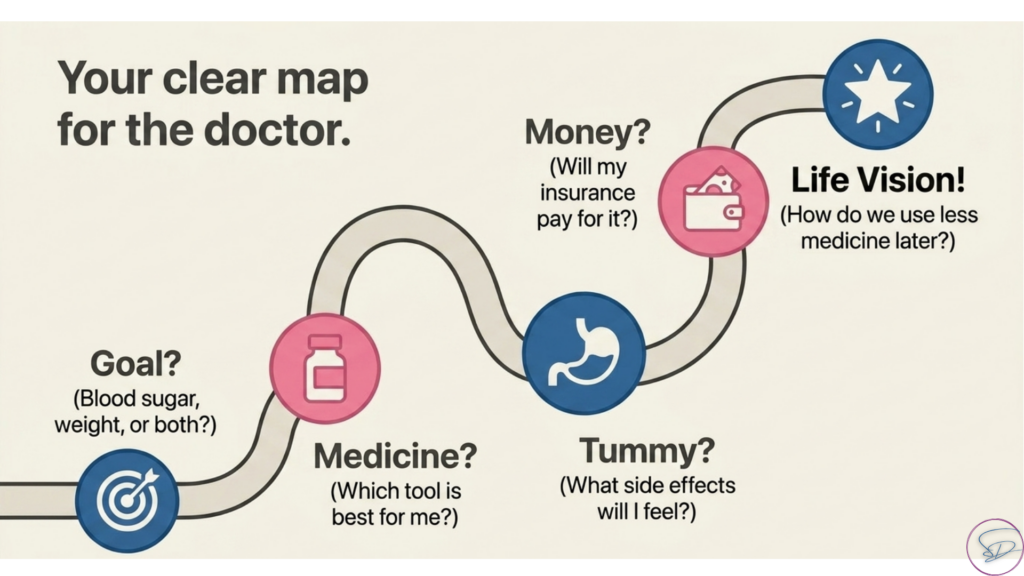
So the full path from start to finish begins with your goal.
What are we actually treating?
It’s not necessarily just diabetes or weight loss, or even anything medical.
We’re treating YOU.
We’re helping you live your life FULLY.
In the medical setting, yes,
- we’re looking at the A1C,
- we’re looking at your weight,
- we’re looking at all of the other labs and quantifiable data that makes sense to the doctor,
and that’s wonderful.
However, we’re using that information to help a human being.
We’re helping you figure out what the best approach is.
How Questions for Your Doctor Translates to Lived Experience
And if we’re looking at different types of GLP-1s, such as Ozempic, Mounjaro, Wegovy, or Zepbound, we need to think about:
- How improving your blood sugar helps improve your relationship with your kids.
- How does improving your weight help you avoid the stares in public, so that you don’t feel so self-conscious and you feel more confident in your own skin?
- How does choosing the best medicine for you ensure that you feel more vital and able to face the world?
- How do the side effects discourage you, and how can we help you through that valley to keep pushing forward?
- And how do we make sure that you continue to have access to the medication that you need at this time in your life?
All of these things are dictated by your life’s vision.
And although the doctor has to follow the clinical logic of this path, you know that it is grounded in your life’s purpose.
Final Thoughts: Let the Medicine Assist You, Not Define You
So let the medicine assist you towards the life you actually want.
If you want to walk into your next appointment with all of this already organized, I put it together for you in a free printable.
You can get your GLP-1 Decision Guide Here.
If you want research on your specific situation instead of a general guide, a Diagnosis Clarity Brief gets you a plain-English summary of the evidence for your condition and questions.
Health and Wellness coaching
Would it be a bad idea to work together now?
If You’re Not Ready Yet, That’s OK.