What’s Left to Eat, Doc?! – 5 Steps
I’ve noticed a lot of people have this question.
And it usually comes up after being told that they can’t have any meats. They can’t have any breads or pastas or sweets. They can’t have any fats.
So after effectively eliminating all three macros, the question comes, “Hey, doc, what’s left to eat?!
That’s a fair question.
So the doctor usually has to acknowledge the fact that you’ve got to eat something.
So, how do you do it?
The doctor needs to
- Adjust the medications,
- Refer you to a nutritionist,
- Or recommend dietary changes and exercise (lifestyle modifications).
But it doesn’t really sit well, does it?
That’s not earthshattering news.
The patient will sit there and pretend to understand, but they’re trying to find that pearl of wisdom that they can take away to apply it to their own life.
And they’re never going to find it because the doctor doesn’t know the ins and outs of each patient’s life.
So, how are you going to do this?
Let’s walk through a few questions.
And hopefully by the end of this video (article), you’re going to have a fresh perspective on the decisions you make throughout your daily life and how that impacts your ability to be present in your life.
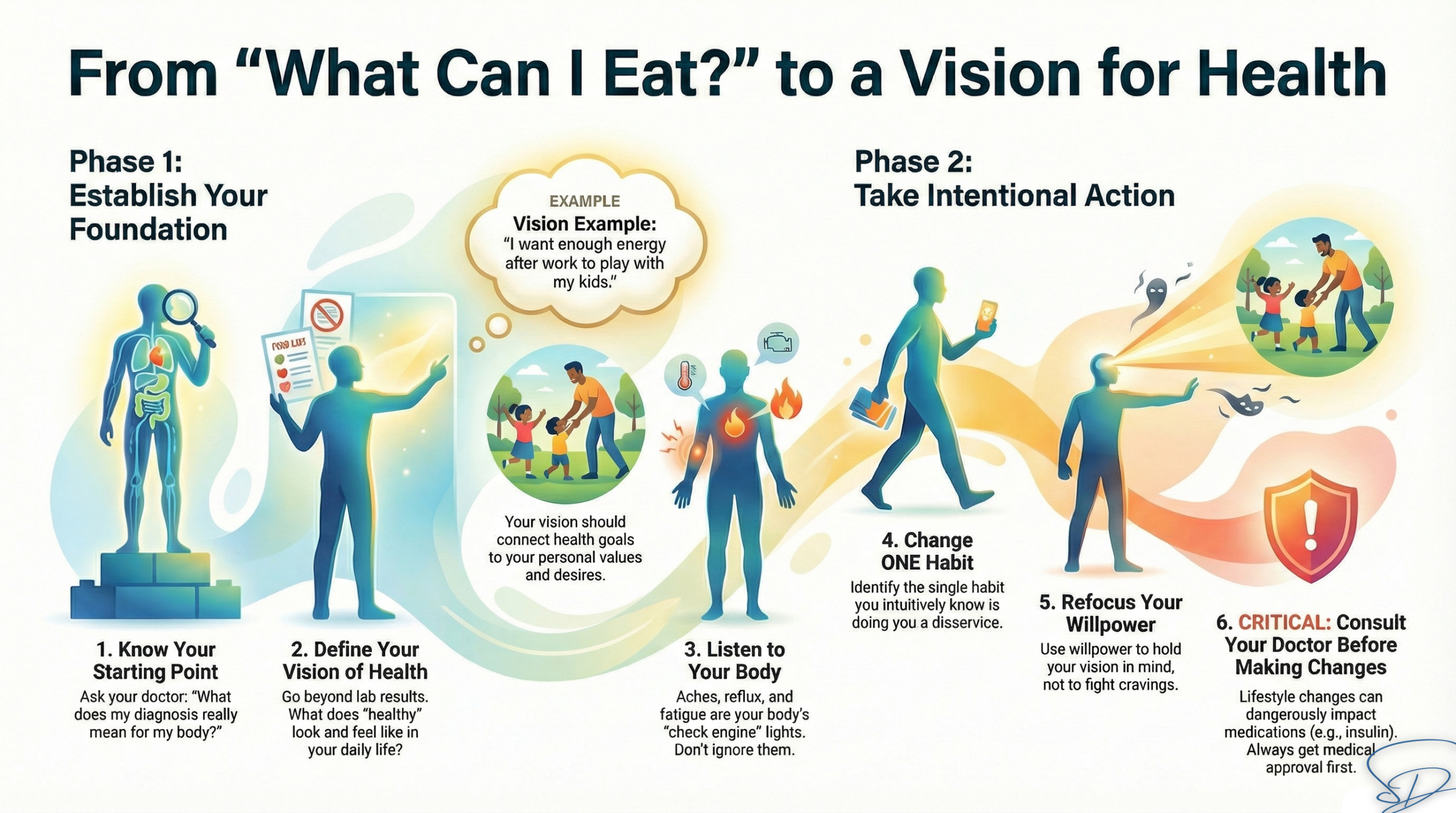
Step 1 – You Are Here
First of all, you need to get clear on what it is the doctor is telling you.
The doctor just said you can’t have this or that.
Fine. What now?
What can you have?
That’s usually the next question.
But really, it’s not that helpful because as the saying goes, “You can give a man a fish and he’ll eat for one meal. You can teach a man to fish and he’ll eat for a lifetime.”
So, the doctor can tell you what to eat, but how do you know if something else you see in the grocery store is okay to eat?
You don’t have the basic principles with which to act on that decision.
So the original question should not be, “Okay, what can I eat?”
The original question should be based on my current condition.
Whether it be high blood pressure, diabetes, high cholesterol, thyroid hormone dysfunction, Crohn’s disease, whatever the case may be.
The question you need to pose to the doctor is, “What is my starting point?”
Oftentimes, we have no idea where we are.
We think we do.
We think that because we named something, we know what it means.
But that’s not the case.
For example, let’s say you went to the mall and you want to find a particular store.
No problem.
Just go to the directory.
Nice great big map that you can stand in front of.
You find the little red dot that says, “You are here.”
Perfect!
You know where you are in the grand scheme of things.
But what if you didn’t even know that you were at a mall? And you just had a great big map of, God knows what, with a little red dot that says you are here?
Would you think that you’re at a mall?
Would you think that you’re at an airport?
Would you think that you’re in the middle of nowhere?
What if the only thing on that directory was a big red dot that said you are here? No map of anything. Just a big red dot.
Okay. So the question is, “Where is here?”
So we need to know where we are.
What is our starting point?
The doctor knows… So ask, “What does this condition really mean?” “Where am I?”
The next step, when you look at this big directory in front of you, is to know what your purpose is.
What is your intention for being at the mall?
You know where you are at this point.
Now you want to know how to get to where you want to go.
You have a vision in mind.
You have a store you want to go to.
You know what it looks like on the outside. You know what it looks like on the inside.
You don’t necessarily even have to know that. You just need to know where you want to go.
So, you need your:
- Starting point
- And you need to know where the end point is going to be
- And you need to know how to get there.
So, in this case, the doctor already has an intention in mind for you.
For example, let’s say you have diabetes. Your A1C is above 7.0.
The doctor wants to bring that A1C down below 7.0.
And for some people, depending on the need of the patient, the goal is actually much lower.
Point being that the doctor already knows what your starting point is, and the doctor already knows where he or she needs you to be.
They have a vision in mind for you, ideally for your best health.
Here’s the question: What is your vision?
Do you have a vision in mind?
Most people would say, “I want to be healthy. That’s why I go to the doctor.”
However, I’ve seen enough frequent flyers to realize that maybe their vision needs to be fixed or adjusted.
But here’s the thing, your lab work does not directly correlate with the values that you have in mind.
You create your vision of health based on your values.
What are those?
- You want to have abundant energy.
- You want to walk this earth and enjoy your time that God has given you.
- You want to play with your kids when you get home from work and not be exhausted and feeling terrible; and you still have to put food on the table. So instead of trying to cook something healthy, you bring home some takeout because you just don’t have the energy to actually make something healthy for your kids and your family.
- And hopefully your spouse took care of it,
- but when you get home and your spouse didn’t take care of it, now you’re irritable even more.
- Now you’re hangry.
- And now the kids see this. And as they see this over and over again, they grow up thinking this is normal.
- And that extends into their own personal relationships.
So let’s cut the snowball effect.
Let’s figure out what is your vision and how do those lab results actually translate to the life that you want to lead.
Step 2 – Tune In
Next step is to listen to your body.
Your body has been talking to you.
- You might have ignored random aches and pains.
- You might have ignored the acid reflux that you get after every meal.
- You might have ignored the dull headache that you get every day.
- You might ignore the fact that you get sick at least two, three, four times a year because it just happens to be that time of year.
However, your body is talking to you.
Your body is actually guiding you towards your destination.
Even if you don’t consciously realize what your vision of health is supposed to be, your body is already designed with the intention in mind to keep you and be as healthy as possible just automatically.
So you would be wise to listen to those aches and pains, those weird signals.
You don’t just drive in your car and see the check engine light go off in the dashboard, and then knock it out and pretend everything is fine.
You need to check that engine.
Otherwise, if your engine hasn’t given up on you already, it will do so sooner or later; and you need to fix whatever the trouble is before it gets too complicated and ends up extremely costly.
Same thing with your body.
If you have:
- A weird ache or pain,
- If you have high blood pressure,
- If you have high blood sugars,
- high cholesterol levels,
- abnormal thyroid function,
- your kidney function is weird.
These are all warning signals that you need to pay attention to.
Listen to what your body is telling you.
Talk with your doctor to figure out what these things mean medically and figure out what to do actually in your day-to-day life.
Step 3 – The “Oh, Yeah” Habit
So, what do you do in your day-to-day life?
At this point, you need to establish some new habits.
Your current habits are what got you here today.
You are the culmination of every decision you’ve ever made to this point.
And now, your body is throwing off warning signals.
All these lights on the dashboard.
Okay. So, how do we turn those lights off?
Obviously, we talk to the doctor. We see what the lights are in the first place.
We know where we are, medically speaking. We know where we want to go.
And now, we’re going to figure out how to get there.
And this is the piece that is difficult to figure out with your doctor because your doctor doesn’t live with you.
They don’t see, minute to minute, what are the challenges you’re facing.
They can’t possibly.
They might appreciate it. They might be able to sympathize with you because after all, we’re all human beings.
However, no matter what, everybody, even if they’re living the same experience, always has their unique set of circumstances that they need to work with.
So, what is just one habit that you can change?
Put it another way, what is one habit that you know is doing you a disservice?
You should have kicked it out to the curb a long time ago. Like a bad habit.
Usually, people know intuitively what that habit is.
It just jumps to mind.
They know instantly.
- Oh yeah, I do need to cut back on those sweets.
- Oh yeah, I do need to cut alcohol.
- Oh yeah, I do need to put the salt shaker aside.
- Oh yeah, I do need to take my medications on time as directed.
- Oh yeah, I do need to go and exercise more and go for a walk.
So, what is the “oh, yeah” moment?
That’s probably the one habit that you can focus your effort on, that can potentially make drastic impact in your health.
A Small Warning
Now, before you act, go and actually change this habit in any way, make sure you run it by your doctor first.
The great irony of health is that any changes to your lifestyle for the better can actually be a detriment to your health.
How can this be?
If you’re already on medications, you need to make sure that whatever changes you make is in line with the effect of those medications.
So, you need to talk to your doctor before you make any changes.
For example, if you have diabetes and you’re on insulin, that dosage of insulin is designed with your current lifestyle in mind.
If you decide to suddenly change your diet and exercise levels, your blood sugar may drop to a dangerously low level, and that can be life-threatening.
So, you need to talk with your doctor first and let them know, “Hey, this is what I’m planning. Do I need to make any changes to my medications before I pursue this?”
If the doctor says, “No, you’re fine,” then proceed as normal.
If the doctor says, “You know what, let’s make these changes,” then you make these changes.
You make sure everything is good and then you proceed.
Again, ALWAYS check in with your doctor.
Step 4 – Aligning Habits to Values
Once you have that habit running, you develop a kind of a system.
The next thing that we need to feel is how this new habit aligns with our value system.
Does it feel right?
This is where people kind of get a little bit woo-woo from what I’ve seen, because this is where people tend to talk about
- Meditation and
- Vibratory sensations
- And energetics
And they never really bring it into the concrete plane of existence.
There needs to be a balance between the spiritual aspect of a person and the physical aspect of a person.
I subscribe to the idea that we are all spiritual creatures having a human experience.
However, I would argue that you don’t necessarily need to meditate on purpose to be in a meditative state or to feel aligned.
When you go out to the grocery store, you might feel drawn to certain things.
Apart from flashy ads, colorful boxes, and packaging that are wrapped up super nice, catchy phrases that might capture your mind, but it doesn’t necessarily capture your heart.
While your mind is saying, “Oo, that looks good,” Your heart is saying, “I prefer a vegetable.”
Nice and boring.
Maybe.
On some level, your heart knows what is good for your body. And your heart knows what is good for your body is paying attention…
Your heart is paying attention to what’s good for your body because your heart wants your body to be healthy, to be present in your life.
Again,
- We want to do a phenomenal job at work.
- We want to have quality time with our kids and our significant other.
- We want to have an adventure on this planet and go places that we’ve never seen before.
And in order to do all those things, it comes down to the fundamental aspect of what decisions are we making on a day-to-day basis that is boring.
Boring and aligned with our values.
Step 5 – The Restoration Phase
And as we make these decisions more and more, we’re beginning to restore ourselves.
We’re beginning to heal ourselves.
We’re beginning to walk in harmony with who we’re meant to be.
And it comes back to our vision of our health.
So here’s the question, What is your vision?
Get as detailed as possible.
It’s super frustrating and very annoying to sit down and actually write out by hand what your vision is.
It’s extremely hard at first.
You’re not used to it.
You feel clumsy.
You feel stupid.
Sounds like a visit to the doctor.
However, if you sit down with it long enough, and you repeat it over and over again, you’ll start to practice becoming a visioneer.
And in so doing, you start to become a creator.
And you won’t have to worry about what habits you might need to reach your vision.
Because as you become clearer about who you are, about who you want to be, and bring that into who you are currently, you’ll start to think a little different.
You’ll start to make the decisions automatically.
You won’t need willpower to fight your craving for those cookies anymore.
You will instead use your willpower to hold your vision in your mind of the new you.
Side-note on the Proper Use of Willpower
It seems to me that most people use their willpower in the wrong way.
They just have to resist the temptation for those cookies in the break room, or those sweets in the fridge, or that ice cream in the freezer, or God knows what else.
And then by the end of the day, what always happens?
Willpower runs out.
Your fuel tank is low.
That ice cream is screaming at you to “come eat me.”
You have three or four pints instead of having had just one or two scoops.
So using willpower in this way is not helpful.
Using willpower towards maintaining the vision in your mind of who you want to be is going to help you immensely.
Because even though you might decide to have some ice cream, you may have that vision where you are the type of person that enjoys ice cream and is still healthy because they do so many other things to balance that ice cream with health.
Back to Restoration
So the question is, what would restore you?
What can you do today?
If you are the person in your vision today, what would you do differently right now?
Don’t worry about distractions. Those will come and go.
However, if there’s one takeaway, it’s to use your willpower, not to decide what foods to eat and not eat.
Use it to keep your healthy vision in your mind and you will naturally choose the foods that will help you either:
- Lose weight,
- Lower your blood pressure,
- Lower your blood sugar levels, etc.
If you want to find out more about how to get clear on this vision, please like and subscribe so that you’ll see when that video (article) comes up.
Thank you!
Health and Wellness coaching
Would it be a bad idea to work together now?
If You’re Not Ready Yet, That’s OK.