Part 1: How to Transform Your Home Into Your Health Ally
When Your Health Goals Feel Like an Uphill Battle
Wouldn’t it be nice if we didn’t have to fight uphill?
Achieving our health goals is already difficult enough.
Now we have to put up with something surprising. Something that should be supportive and understanding.
I am talking about home.
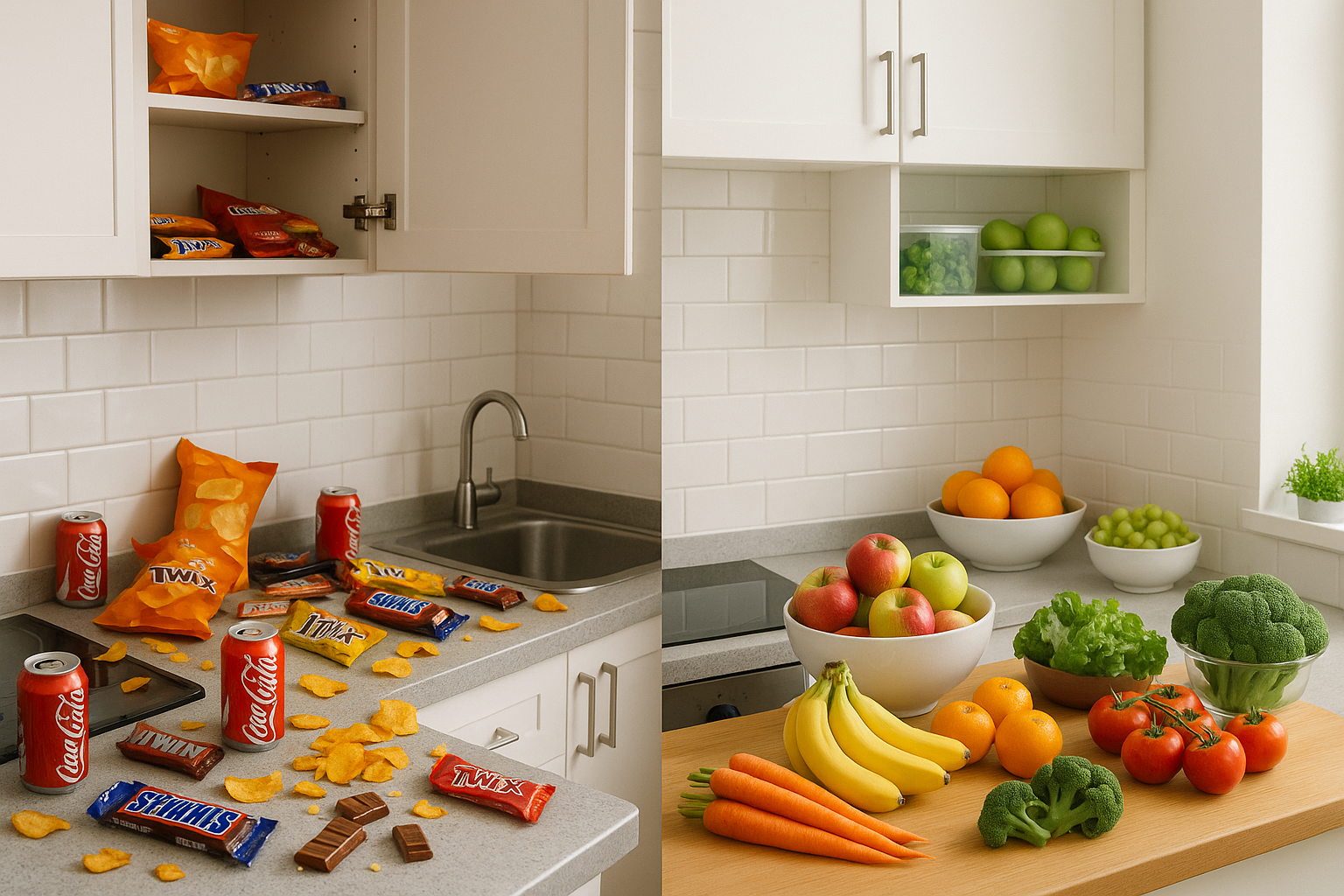
It seems family members wave their wands so that frozen dinners pack our freezers, sweets magically appear on our countertops, and take-out conveniently adorns our dinner tables.
So what do you do when your environment does not support your health goals?
It feels like things would be a lot easier if you lived on your own or with someone who shares your awareness.
But here’s the thing, you share values with those around you. We just have a different way of expressing these values and meeting our needs.
So when it seems like everything and everybody is working against you, let’s step back a moment.
Put down the frustration and angst, and back away slowly.
What do you see when you expand your vision?
Let’s recognize that they’re not trying to sabotage you. Their version of “normal” can make your goals feel harder.
You see life as it is, so that you can proceed with grace.
Without sounding religious, there is a parable of the wheat and weeds.
A farmer sowed good seed in his field. His enemy sowed weeds into his field during the night.
The workers thought to pull up the weeds.
However, the farmer knew that this process would destroy the good wheat. So he instructed the workers to let the weeds grow with the wheat.
When the harvest came, they were able to keep the wheat and destroy the weeds separately.
Obviously, the farmer could have been upset. He could have torn up the weeds in frustration, and destroyed his crop in the process.
He could have taken revenge by sowing weeds in his enemy’s field.
But that would waste time, money, and other personal resources.
His enemy would win either way!
Instead, the farmer chose the graceful option.
He took a step back. He saw that the weeds did not harm the wheat.
So he made a wise decision.
How do we take the farmer’s wisdom back home?
How do we navigate a world full of weeds and nourish our bodies wisely?
Communicating with Family
We start at home.
I have had a lot of angst with my family and the foods that they bring home.
It got so ridiculous that I found myself melting buckets full of ice cream in the bathtub because our freezer could not hold anything else.
The difficult thing is that family members are often well-meaning.
For example, my dad is kind and compassionate. He always offers me whatever he’s eating.
The catch?
It usually doesn’t align with my goals. But he feels bad for me if I don’t eat “real food”.
So in his mind, if I don’t share his meal, then I’m not eating well.
He’s supportive in his own way.
My mother appreciates how I eat. So she’s concerned when I don’t eat the broccoli she made.
Here’s the catch:
I already had a serving that she didn’t see, and I planned to have more after finishing my plate.
Again, this comes from a place of love, but these personal examples show how family can unintentionally become obstacles.
Research has shown that family influences how we see food, and we carry this idea into adulthood.1,2
So I would challenge you to think critically before labelling something or someone as “unsupportive”.
Often, we share the same values. We just express them differently.
So what small step can we take today that improves communication?
Communicating with your household
Your household has a lot of influence on your food choices and what you think is food.
Don’t believe me?
Here’s a small thought experiment:
What’s really the difference between:
- Toast
- Tortillas
- Cake
- Spaghetti
- Chips
- Soda
They may have different ingredients. However, they all seem to use carbohydrates to make any shape they want. Carbohydrates are like Play-Doh.
So how do you actually have these conversations with family?
The key is to know that most people are not trying to sabotage you. They have their own idea of normal.
When my dad offers me food that doesn’t align with my goals (even after I told him a thousand times), he’s genuinely trying to show love and make sure I’m well-fed.
When my mom questions why I’m not eating something (even though I already did and will get more later), she’s worried that there’s something I didn’t like.
So we start with appreciation and gratitude.
After saying the same thing a thousand times, and after you feel like they should know you by now, you won’t feel appreciative or grateful.
“Why should I have to tell them, AGAIN! Shouldn’t they know by now?”
I get it.
In that case, say, “Thank you” or “No, thank you”, and move on.
Otherwise, if you explained it less than a thousand times:
- Start with appreciating the offer.
- Explain your goals.
- Ask for support.
- Then define what support looks like.
For example, “Thank you for making sure I’m eating well. I’m making some changes to reach my health goals right now. It would mean a lot to me if you could help me by putting more vegetables on the table.”
Remember, these conversations aren’t one-time events. Your family has years of experience with food before you were a sparkle in their eye.
Change takes time. Be patient.
We would be a fool to think we can control what everyone else does.
The goal is to create enough space and understanding so you can focus on what you can control.
And what is one strategy that you can use right away?
Creating “safe zones” for your food
What are “safe zones”?
Safe zones are places you can easily see and access. Ie: countertops, tables, front and center in the fridge or freezer.
Safe zones are prime real estate in your house. Why?
Research has shown that people eat what they see and what is easily available.3,4
So, if you have energy-dense snacks like chips and cookies, or whole foods like nuts or vegetables, people will eat more of it if:
- You can clearly see it
- You can easily get it
If that’s the case, then why do we usually have processed foods on our countertops and in our pantry?
I’m not sure. My guess is that they usually have a longer shelf life than whole foods. And processed foods are much more appealing to the senses.
So what are some practical ways to reclaim these safe zones in the name of whole foods and your health?
I use one life hack: Mindfully design your environment with the right food cues.
The Battle of the Countertop

What whole foods have a good “shelf life”?
I don’t keep much on my countertop.
- Olive/coconut/avocado oils
- Nuts and/or seeds
- Apples or bananas
- Vegetable du jour
My brother enjoys green beans. Don’t ask me why. He just grabs them like chips.
The point is that if you explore the produce section with fresh eyes, you can find something that you enjoy and can stay on your counter for a few days.
The Battle of the Cupboards
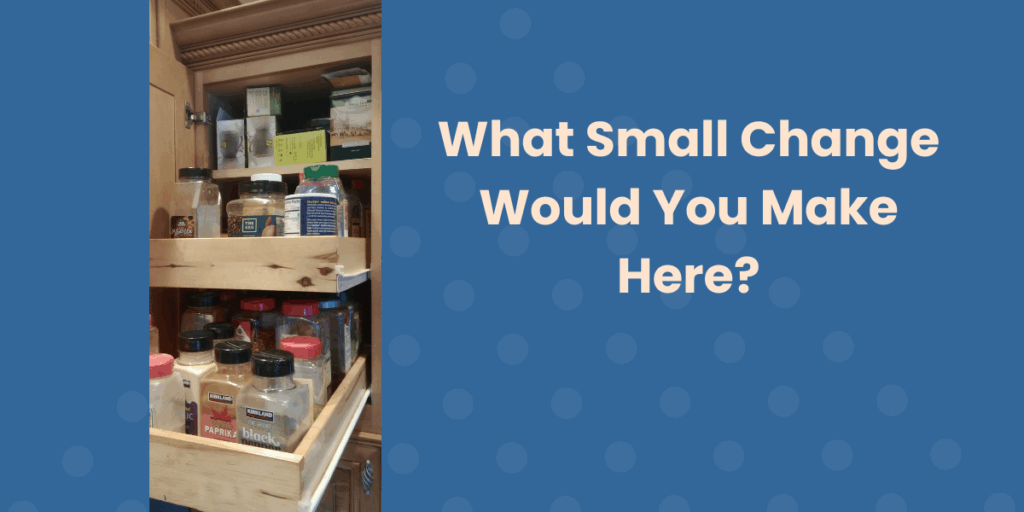
My cupboards are filled with:
- Spices
- Lentils (canned or dried)
- Nut butters
- Tea
- Apple cider vinegar
- Balsamic vinegar
I prefer cooking. I’m not good at it.
But I taught myself the basics of how to boil water, how to use a pot and pan, and how to use a crock pot.
Then I just add spices to taste.
The Battle of the Fridge and Freezer
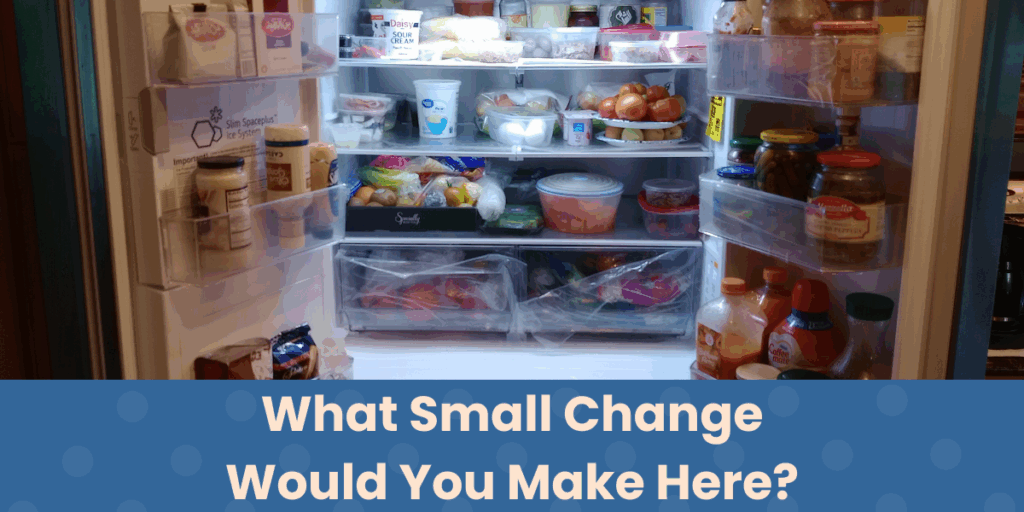
Open the door, and the first thing you see is?
What does your eye find?
In the example I gave, my eye finds a mess!
But when with family, you have to appreciate the wheat you’ve sown.
I envision a perfect field where my eye finds:
- Eggs
- Vegetables/fruit
- Salsa
- Hummus
- Chicken/turkey/beef/fish
- Last night’s left overs (from a prepared meal)
- Meal prepped tupperwares
Keep in mind, there will be a transition period.
Restaurant leftovers took the majority of my fridge real estate. And “healthy” frozen dinners claimed my freezer.
However, I started paying attention to nutrition facts.
From there, I made decisions that slowly phased in healthful choices.
Over time, the unhealthy choices weren’t given another thought. If they weren’t on the radar, then they fell off the map.
Food for thought
If you have to fight your natural food cues, you’ve already lost.
The value of this approach is that you work with your natural food cues. And the genius is that you only focus on adding healthy items instead of removing unhealthy items.
That bowl of candy or bag of cookies can stay on your counter. Alongside fruit and vegetables. You might be tempted by the sweets, and you will feel reminded to have a fruit or vegetable with it.
But the real improvement does not come from the guilt-trip.
The real improvement comes from convenience.
When healthy food is just as easy to grab, it actually helps improve your diet.
You’ll run out of cookies. And when you do, it will be easier to eat that fruit instead of running to the store for more cookies.
So how do you start?
Start Small, Think Addition Before Subtraction
We want to rebalance your environment by adding healthy options to your counter tops, cupboards, and fridge/freezer.
For example:
- Add a bowl of fruit and vegetables next to the bowl of cookies.
- Get some ziploc bags and make a “trailmix” of veggies. (you can often buy vegetable medleys already prepared)
By making healthier items easier to pick, you gradually lose interest in unhealthy foods in the house.
You don’t necessarily lose interest on purpose, but by choosing the healthy alternatives you feel better and don’t think to replace the processed foods when they run out.
You might finish that bag of cookies, but you might not automatically think, “Oh, I need to go buy more cookies.” Instead, you reach for the apple or the nuts that are within arm’s reach for you.
Conclusion: Your Home as Your Health Ally
Your home can either drain your willpower or support your goals.
Creating safe zones, communicating with family, and placing healthy foods front and center can help you make nourishing decisions easier.
Just remember:
It won’t happen overnight.
But, you can start small.
So how can you create one safe zone in your home this week?
I only named the counters, fridge, and cupboards.
If those work for you, then that is great!
If they don’t work for you, then expand your horizons within your home.
With patience and a little creativity, you can transform your home into a place that makes healthy choices the default.
Of course, the home is only part of the story.
We face the next challenge outside our house.
In Part 2, we take a quest to the grocery store.
We will explore how to navigate countless food temptations that line the aisles.
We will arm ourselves with meal plans and shield ourselves with knowledge of smart shopping strategies to make success almost automatic.
Health and Wellness coaching
Would it be a bad idea to work together now?
If You’re Not Ready Yet, That’s OK.